Boats · basics
Anatomy of a packraft
Packrafts look simple, but each part has a job. Once you know the names, spec sheets make sense and a failing part is easier to spot early.
Last checked November 2026
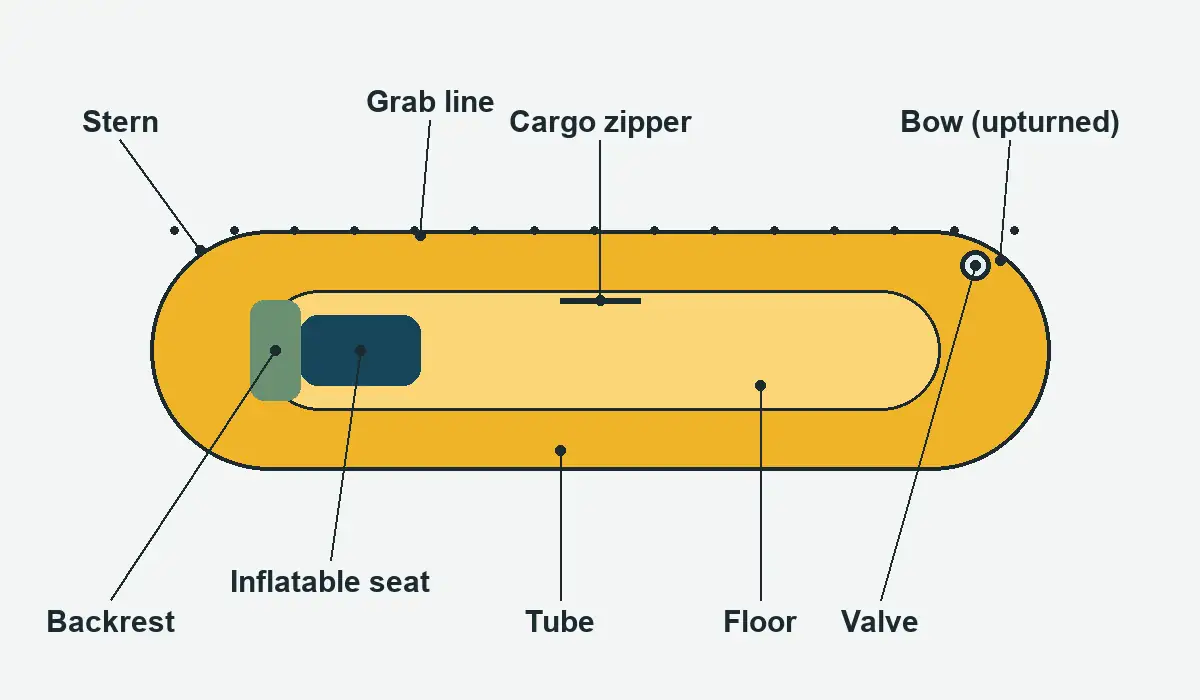
Most packrafts share the same basic layout, and brands differ mainly in tube shape, fittings and how the deck attaches. Below are the parts you will find on nearly every boat, what each one does, and what happens when it stops doing it. The packraft overview covers how they come together in different designs.
The parts at a glance
| Part | Where it is | Main job | Usual material |
|---|---|---|---|
| Tubes | The air-filled ring around you | Buoyancy, shape, wave deflection | Coated nylon, lighter than the floor |
| Bow and stern | Front and back ends of the tube | Steering behavior, tracking, wave riding | Same as tubes |
| Floor | Stretched across the bottom | Holds you up, takes abrasion | Heavier coated fabric |
| Inflation valve | Usually on the stern or side of the tube | Main fill point for the inflation bag | Plastic valve body glued or welded in |
| Top-up valve | Near the cockpit | Adds pressure by mouth | Small valve, sometimes on a short hose |
| Seat and backrest | Inside the cockpit | Posture, comfort, insulation | Inflatable cushion or foam |
| Deck attachment | Around the cockpit rim | Holds a spray deck | Zipper, hook-and-loop or coaming |
| Grab lines and D-rings | Along the tubes and bow | Carrying, rescue, lashing a pack | Webbing, cord, glued patches |
| Fin box | Under the stern | Mount for a tracking fin | Glued-on plastic housing |
Tubes
The tubes, sometimes called pontoons or sidewalls, are the air-filled ring that gives the boat its buoyancy. Bigger diameter means more flotation and a drier ride in waves, at the cost of more fabric and weight. Many boats taper the tube toward the ends. Some use one continuous chamber, others split the boat into two chambers so a puncture in one leaves you with some flotation. A two-chamber boat needs a valve for each chamber.
Tube pressure matters more than most new paddlers expect. A soft tube flexes in the middle when you hit a wave, and the boat folds and feels sluggish. A firm tube keeps the hull rigid so your strokes move the boat instead of bending it. Air also cools and contracts when you put a sun-warmed boat into cold water, so a boat that felt hard on the beach can feel soft ten minutes later. That is what the top-up valve is for.
Chambers and baffles
A single-chamber boat is the lighter and simpler option: one valve, no internal walls, fewer seams. Its drawback is that a big tear anywhere drains the whole tube. A two-chamber boat puts a baffle, an internal wall, somewhere in the tube, often near the bow or splitting the boat side to side. Lose one chamber and the other still holds you and your pack high enough to reach shore.
Whether the second chamber is worth its weight depends on where you paddle. On a lake crossing a short swim from shore, many people accept one chamber. On a remote canyon trip with sharp rock and cold water, a second chamber is cheap insurance. Boats with cargo zippers in the tubes also have to think about chambers, because the zipper opens into the tube and the gear stored there sits inside the air space.
Bow and stern
The bow is the front, the stern the back. A short, round stern makes a boat spin easily, which is fun on flatwater and annoying when you are trying to go straight. Boats built for rapids usually stretch the stern so the boat tracks better and does not get pushed around as much by waves. Many also raise the bow so it rides over waves instead of punching into them. The whitewater packraft article goes into these shapes in more detail.
The bow also carries your load. Most paddlers strap their pack across the bow tube, and that weight pushes the front down. A bow with more upward sweep, or rocker, keeps a loaded boat from plowing into small waves.
Floor
The floor is a sheet of heavier coated fabric glued or welded to the bottom of the tubes. It takes most of the abrasion from rocks and gravel bars, so it is usually tougher than the tubes. Some boats add a separate inflatable floor pad on top for insulation and stiffness. Self-bailing designs have a floor with drain holes or an inflatable floor that sits above the waterline, and the self-bailing packraft guide explains how those drain.
How the floor joins the tubes is one of the main differences between models. A floor set low hangs slightly below the tubes and gives a more stable, flatter ride. A floor raised up into the tubes reduces drag but leaves you sitting lower in the water. Either way, the seam along that join is a high-stress line, and it is one of the first places to inspect on an older boat.
Valves
You will usually find two kinds of valve. A large inflation valve takes air from an inflation bag. A smaller top-up valve, sometimes on a short flexible tube, lets you add pressure by mouth once the boat is full or after it has cooled in cold water. Some boats also have a dump or deflation valve. How you use each valve is covered in the guide to inflating a packraft.
Most main valves are one-way with a removable cap. The one-way flap keeps air in while you pump; the cap seals it for the day. Grit on the threads or the sealing surface is the common cause of slow leaks, so keep sand out of the valve when you inflate on a beach. Check that the cap is snug before you push off. A loose cap is a much more common problem than a torn tube.
Seat and backrest
Most seats are separate inflatable cushions clipped or tied into the cockpit. A firm seat raises you for better paddling posture, while a lower seat makes the boat feel more stable. Backrests range from a simple inflatable bolster to an adjustable backband that whitewater paddlers lean against to stay connected to the boat.
The seat is also insulation. Sitting on a thin floor on cold water chills you from below in a way that a jacket cannot fix. An inflated seat, or a foam pad under you, puts air or foam between you and the river.
Spray deck attachment
Boats meant for rough water have some way to fix a deck over the cockpit. You will typically see a zipper or a strip of hook-and-loop running around the tube, or a coaming rim the skirt stretches over. Each option is compared on the spray deck page.
Grab lines, D-rings and loops
Handles at the bow and stern are for carrying or dragging the boat. Grab lines along the tubes give a swimmer something to hold, and D-rings or webbing loops on the bow are where you lash a pack or a bike. Whitewater boats add anchor points inside the cockpit for thigh straps, which are covered in the article on backbands and thigh strap fitting.
Each D-ring sits on a fabric patch glued to the tube. The patch spreads the load across the fabric. If you haul a loaded boat up a bank by one D-ring, all that force lands on one patch, and patches peel. Lift by the end handles and spread lashing loads across two or more points.
Fin options
A short packraft yaws with every stroke. A removable tracking fin under the stern helps a lot on lakes and slow rivers. Fins usually slide into a glued-on fin box. Take the fin off for shallow or rocky water, since it can snag and stress the floor.
What each part does when it fails
Each part fails in its own way, and most failures can be handled in the field for long enough to finish the day. The repair guide covers the patching methods in detail.
| Part | Typical failure | What you notice | Field response |
|---|---|---|---|
| Tube | Puncture or abrasion hole | Boat softens, hissing, bubbles in water | Dry the area, apply tape or a patch, re-inflate |
| Chamber baffle | Leak between chambers | One side refills the other; hard to keep both firm | Usually a home repair; paddle carefully |
| Floor | Abrasion wear, pinhole, cut | Water seeping into the cockpit | Tape from outside when dry; floor patches hold well |
| Floor-to-tube seam | Seam lifting | Slow water entry along the edge, visible gap | Tape as a stopgap; proper re-glue at home |
| Inflation valve | Grit in seal, loose cap, cracked body | Slow overnight loss, air escaping at the valve | Clean and reseat the cap; a cracked body needs replacement |
| Top-up valve | Stuck open or torn hose | Air loss while paddling | Close and tape over it for the day |
| Seat | Seat valve leak | Sinking lower each hour | Top up, or swap in a foam pad |
| D-ring patch | Patch peeling at one edge | Patch lifts when loaded | Move the load to other points; re-glue later |
| Fin box | Box loosening from floor | Fin wobbles, box edge lifts | Remove the fin and paddle without it |
Reading a spec sheet with this vocabulary
Once the names make sense, product listings get much easier to compare. A few things to look for:
- Tube diameter and taper: larger tubes give more buoyancy and a drier ride, and they weigh more.
- The number of chambers, including any separate floor or seat chamber.
- Floor fabric, often described by denier and coating, which the fabric guide explains.
- The deck system: zipper, hook-and-loop, coaming, or none.
- Fittings. Count the D-rings and look for thigh strap anchor points if you plan on rapids.
- Stated capacity. Compare it with your body weight plus your heaviest pack, and leave a margin.
When you shop second-hand, the same list becomes an inspection checklist. The guide to checking a used boat before you pay walks through the order.
Keeping the parts in good shape
Most wear comes from three things: grit, sun and storage. Rinse sand out of valves, zippers and the floor seam after a trip. Keep the boat out of strong sun when you are not paddling, since UV slowly degrades coatings. Store it dry, loosely rolled or partly inflated, away from heat. The storage and cleaning routine has the full steps.
How many chambers does a packraft have?
Most have one or two main tube chambers. Some also have a separate inflatable floor or seat, which counts as its own chamber with its own valve.
Why does my packraft go soft on the water?
Usually because the air cooled when the boat went from warm sun into cold water. Top it up with the small valve after a few minutes on the water. If it keeps softening, check for a leak.
Which part of a packraft wears out first?
The floor and the seam where the floor meets the tubes take the most abuse from rocks and gravel. Valves and D-ring patches are the next most common trouble spots.
Do I need a tracking fin?
On lakes and slow rivers a fin makes a short boat much easier to keep straight. On rocky or shallow rivers, leave it off so it does not snag.
What is the difference between the inflation valve and the top-up valve?
The inflation valve is the big fill point you use with an inflation bag. The top-up valve is smaller and is for adding a little pressure by mouth once the boat is nearly full.