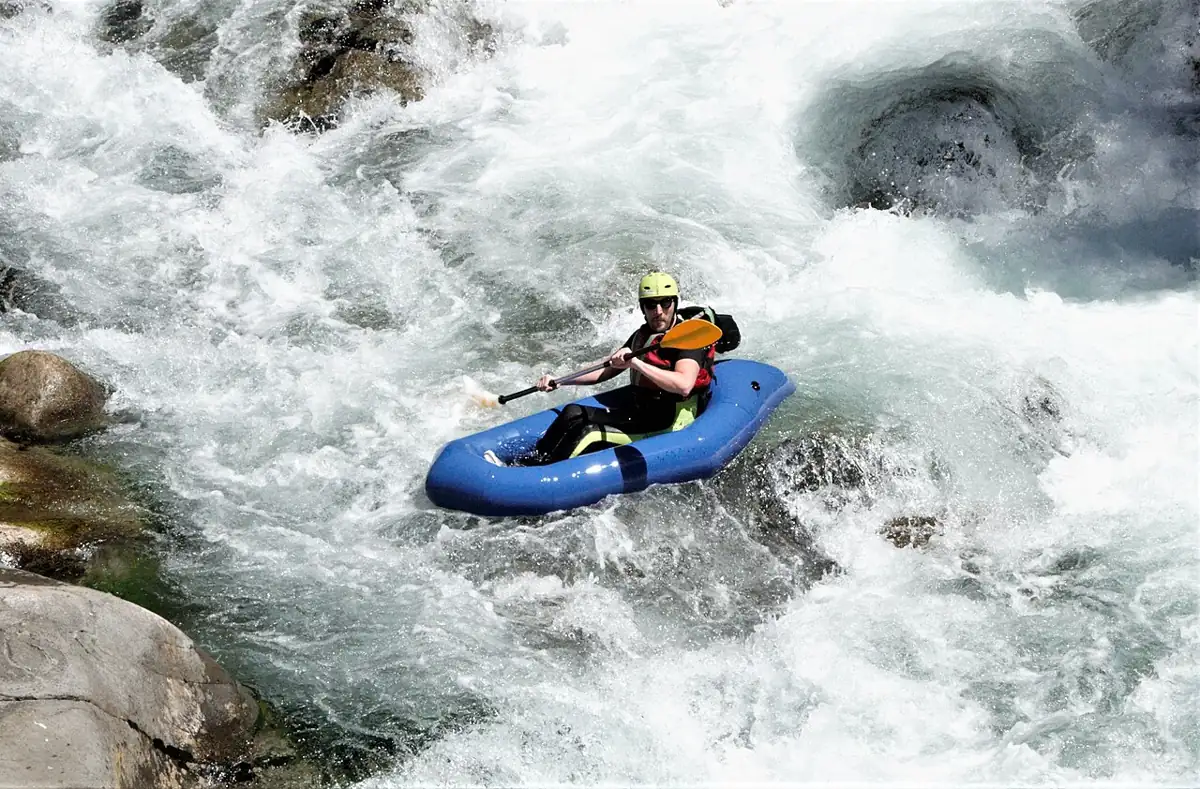
Boats · whitewater
What makes a whitewater packraft
Any packraft will float through a rapid, but steering one through a hard rapid takes a boat built for it. Most of the difference is in hull shape and the outfitting that ties you to the boat.
Last checked November 2026
Early packrafts were short, round boats that bounced off rocks and spun in eddies. Skilled paddlers ran hard water in them anyway, but they spent a lot of effort just keeping the boat pointed. Modern whitewater packrafts borrow from kayak design: the paddler is strapped in, and the hull is shaped to hold a line through waves and holes.
If the vocabulary is new, the parts of a packraft page names everything used below. The packraft guide shows where whitewater boats sit among the other designs.
Whitewater boat vs touring boat
A touring boat is built to be carried a long way and paddled on mixed water. A whitewater boat gives up some of that portability for control in rapids.
| Feature | Typical touring boat | Typical whitewater boat |
|---|---|---|
| Stern | Shorter, rounder | Longer, with more buoyancy behind you |
| Bow | Moderate rocker | More rocker to climb waves and holes |
| Tube size | Moderate | Larger, toward the top of the usual range |
| Outfitting | Seat, simple backrest | Seat, backband, thigh straps, foot brace |
| Spray cover | Optional cruiser deck or none | Whitewater skirt, or an open self-bailing cockpit |
| Floor | Lighter fabric | Heavier fabric, sometimes reinforced |
| Weight | Lighter | Often noticeably heavier |
| Flatwater feel | Easier to paddle in a straight line | Slower, sits deeper with outfitting and deck |
| Best water | Lakes, Class I to II rivers | Class III and up, steep creeks, big volume |
Plenty of boats sit in the middle, sold as all-round or expedition designs, and many touring boats take thigh straps as an add-on. When you compare two models, count how many items from the right-hand column each one has and check that the outfitting and hull suit each other.
Hull shape
Most whitewater designs extend the stern. The extra waterline length helps the boat track and makes it harder for waves to kick it sideways, and the buoyancy behind the paddler cuts down on back-endering in holes.
The bow usually has more rocker, so it climbs waves and rides up over the foam pile of a hole instead of diving in. Tubes tend to be large, often toward the upper end of the typical 11 to 13 inch range. Bigger tubes add buoyancy, shed water and raise the sides around you, which keeps more water out of the cockpit.
How shape feels on the river
A longer stern changes how the boat responds to your strokes. It holds a ferry angle across a current more easily, and it does not spin out the moment a wave hits one side. You pay for that in quick turns: a short, round boat pivots on the spot, while a long-sterned boat needs a stronger sweep or an edge to turn. Paddlers moving up from a touring boat often notice they have to plan moves a little earlier.
Tube size has a similar trade. Big tubes keep you drier and make the boat harder to flip, but they also put your hands farther out to the side, which can make a vertical forward stroke more awkward for smaller paddlers. Fit matters here, and the sizing guide covers how cockpit length and tube size relate to body size.
Outfitting
Outfitting is the gear that links your body to the hull, so the boat responds to your hips and knees as well as your paddle.
- Thigh straps run from anchor points near the seat, over your thighs, to points in the bow. Pressing up with your knees lets you edge the boat and, with practice, roll it. Fitting them is covered in the article on thigh straps and backbands.
- A backband holds your hips forward so you do not slump, which keeps your stroke powerful.
- A foot brace, usually an inflatable bolster or foam block, gives your feet something to push against.
- A firm seat raises your hips for a better paddle angle.
The four pieces work as a set. Straps without a foot brace let you slide forward, and a backband without straps only does half its job. When you set up a boat, adjust them in the order you sit: seat height first, then backband, then foot brace, then straps.
Outfitting checklist
Run through this list before the first trip on a new or newly outfitted boat, and again at the start of each season.
- Seat inflated firm enough that your hips sit level and do not sag to one side.
- Backband snug against your lower back, with the buckle or strap ends out of the way of your hands.
- Foot brace positioned so your knees bend and press up into the straps without cramping.
- Thigh straps crossing the middle of your thighs, not your knees or your hips.
- Strap anchor points checked for lifting edges on the glued patches.
- Quick-release buckles, if fitted, tested wet with cold hands.
- Spray skirt release loop on top and easy to grab, if you run a deck.
- Nothing loose in the cockpit that could wrap a leg: tuck strap tails and spare cord away.
- Grab lines tight along the tubes, with no slack loops a foot could slip into.
- A wet exit practiced in calm water with this exact setup.
Spray deck
In big water, a full spray deck with a release handle keeps the boat from filling. A swamped boat is heavy and sluggish, and it flips much more easily. Whitewater decks are usually a firm deck with a skirt that seals around your waist; the deck and skirt comparison goes through the options. Some whitewater paddlers skip decks altogether and choose a self-bailing boat, especially on warm, splashy rivers.
Personal gear that goes with the boat
A whitewater boat assumes you are dressed and equipped for swimming. Wear a properly fitted life jacket every time, and pick one cut for paddling so it does not ride up when you are in the water; the life jacket guide explains fit and labels. A whitewater helmet is standard on rocky rapids, since a flip in shallow water puts your head close to the riverbed. On cold rivers add a drysuit or wetsuit, which the page on drysuits and layers for cold rivers covers in detail. Carry a throw bag and a knife you can reach with one hand, and know how to use both.
What you give up
| Feature | Benefit in rapids | Cost |
|---|---|---|
| Long stern | Tracking, stability in holes | Weight, packed size |
| Thigh straps | Edging, rolling, control | Setup time, needs training |
| Full spray deck | Dry cockpit | Heat on warm days, extra weight |
| Heavier floor | Survives rocks | Weight |
A fully outfitted whitewater boat with a deck often weighs twice as much as a light lake boat. That weight is hard to justify on a long hike-in with mostly flat water. On a trip with continuous Class III it pays for itself, since a lighter boat would leave you swimming more often.
Common mistakes when moving up to whitewater
Most of these trace back to setup and habits.
- Running loose straps. Straps that are too slack give no control, and you are still attached to the boat. Snug them or leave them off until you have practiced exits.
- Skipping the wet exit drill. The first time you flip strapped in should not be in a rapid.
- Under-inflating. A soft boat folds in holes. Top up after the boat cools in the water.
- Buying more boat than the water needs. If most of your trips are flat, a heavy whitewater rig will feel like a burden on every hike.
- Treating the boat as a skill. A better boat makes good moves easier but does not teach you to read a rapid; the guide to reading whitewater and time with an instructor do that.
Who it suits
These boats suit paddlers who run rapids regularly or plan to learn. The boat still needs a skilled paddler, so pair it with instruction, rescue training and a clear sense of how rivers are graded before you go looking for harder runs. A packrafting course with a whitewater component is the fastest way to learn rolling, edging and rescue in a controlled setting.
Can I run Class III in a touring packraft?
Skilled paddlers do, but it is harder work. Without thigh straps and a longer stern, the boat is easier to flip and harder to steer, so you are more likely to swim.
Do I need thigh straps for whitewater?
They are what let you edge and roll the boat. Many paddlers run easy rapids without them, but on harder water they make a large difference. Practice wet exits before relying on them.
Is a whitewater packraft harder to paddle on flatwater?
Usually a little. The extra weight and outfitting make it sit deeper, and a skirt adds heat. Most people find it fine for short flat sections and tiring on long lake crossings.
Spray deck or self-bailer for whitewater?
Decks suit cold water and mixed trips. Self-bailers suit warm, continuous rapids and paddlers who want a simple exit. Many whitewater paddlers end up with both options.
Can I add whitewater outfitting to a touring boat?
Some touring boats have anchor points or accept add-on thigh straps and backbands. Check what the boat was designed for before you glue on new fittings yourself.