Boats · fit
Choosing a packraft size
Packraft fit is mostly about your legs. With the right cockpit length your feet brace against the bow and the boat follows your body; with the wrong one you spend the day sliding around or cramped.
Last checked November 2026
Many packraft models come in several lengths, often labeled small, medium, large or by a size number. The labels are not standard across brands, so compare actual measurements rather than names.
Most makers publish a size chart that links paddler height or inseam to a boat size. Those charts are a good starting point, but they assume an average build. Long legs and a short torso, or the reverse, can put you in a different size from your height alone, so it pays to know what each measurement means and to check the fit with your own body.
What size controls
Cockpit length is the distance from the back of the seat to the inside of the bow. Your feet should reach the bow with your knees slightly bent. In a cockpit that is too long you slide forward with nothing to brace against, and in one that is too short your knees jam up, which hurts after an hour and makes paddling awkward.
Width affects stability and how easily your paddle reaches the water. Wider boats are steadier and slower.
Capacity is how much weight the boat can carry and still handle well, counting you, your gear and anything strapped to the bow.
Why leg contact matters
A packraft has no rigid hull, so you steer and brace through your body. When your feet press on the bow tube and your knees push up or out, the boat moves with your hips. You can lean it onto an edge, hold it straight in a wave and stay seated when it bucks. Without that contact, your paddle strokes push you around inside the boat instead of moving the boat. The packraft parts guide shows where the seat, backrest and bow tube sit relative to each other.
What the numbers on a spec sheet mean
| Spec | What it tells you | What to watch |
|---|---|---|
| Overall length | Outside length of the inflated boat | Not the same as cockpit length |
| Inside or cockpit length | Seat back to bow, inside the tubes | Check whether it is measured with the seat in place |
| Overall width | Outside width | Affects paddle reach and stability |
| Tube diameter | Size of the main tubes | Bigger tubes add buoyancy and height |
| Load or weight capacity | Total weight for good handling | Often lower than the maximum the boat floats |
| Recommended paddler height | Maker's rough guide | Based on average proportions |
Measuring yourself
- Sit on the floor with your back against a wall and legs out straight.
- Bend your knees slightly, as if bracing against a boat's bow.
- Measure from the wall to the soles of your feet. This is your rough cockpit length.
- Compare with the cockpit lengths listed for the models you are considering, allowing for the thickness of the backrest and foot bolster.
- Add your body weight to your typical loaded pack weight to check against capacity.
Inseam and height give a rough guide, but torso length and flexibility vary. Whitewater paddlers with thigh straps tend to prefer a snugger fit; flatwater paddlers often like a little extra room.
Do the measurement wearing the shoes you paddle in. River sandals and neoprene booties add very different amounts, and a boat that fits barefoot may be cramped in thick-soled shoes. The paddling footwear notes cover what most people wear.
A worked example
Say a paddler measures their wall-to-sole distance with knees slightly bent and gets a number. They then look at two sizes of the same model. The smaller size lists a cockpit length a little shorter than their measurement. The larger lists one a few inches longer.
- First, subtract the backrest. If the backrest is an inflatable block that takes up a few inches when full, the larger boat's usable length shrinks toward their measurement.
- Next, think about use. For mostly lake paddling and long hikes, a bit of extra room is comfortable and easy to fill with a dry bag at the feet.
- For rapids with thigh straps, they would want the snugger fit, and the smaller boat could suit if their knees are not jammed.
- Finally, check capacity. Their body weight plus a multi-day pack should sit well within the larger boat's rating. If it comes close to the smaller boat's limit, that settles it.
In this case the paddler chooses the larger size for multi-day touring and plans to pad the bow with a stuff sack. A friend of the same height with shorter legs might fit the smaller size perfectly, even though a height chart would put them both in the same boat.
Too big or too small
| Symptom | Likely cause |
|---|---|
| Sliding forward, no brace for feet | Boat too long |
| Knees high and cramped | Boat too short |
| Bow buries in waves | Overloaded or boat too small for you plus gear |
| Boat feels like a cork, spins easily | Boat too big and light for your weight |
| Thigh straps can't be tightened | Cockpit too long for straps to reach |
A foot bolster or rolled dry bag can fix a slightly long cockpit. A short cockpit cannot be fixed, so if you are between sizes, the longer option is usually easier to adjust.
Ways to tune a boat that is close
- Add a foot brace: an inflatable bolster, a dense stuff sack or a rolled dry bag wedged against the bow.
- Adjust the backrest. Inflating it more pushes you forward; letting air out gives more room.
- Use a thicker or thinner seat. A higher seat improves paddle reach but raises your center of gravity.
- Set up thigh straps carefully. The thigh strap and backband guide explains how to position them for your leg length.
Capacity and load
A maker's capacity figure describes the load at which the boat still handles well, which is usually well below what it would take to sink it. A boat loaded close to that limit sits low, takes water over the tubes in waves and feels sluggish. As a rough habit, add up your weight, your clothing and paddle, your pack and anything else (a bike, a dog, a cooler of fishing gear) and look for a boat that carries that total with room to spare.
| Use | What to add to body weight |
|---|---|
| Day trip on a lake | Clothing, small day pack, water |
| Multi-day river trip | Full camping kit, food, water, repair kit |
| Bikerafting | Bike, bike bags and camping kit |
| Dog aboard | The dog's weight plus its life jacket |
If you plan to carry a bike, read the bikerafting setup notes as well; a bike on the bow changes how the boat sits even when the total weight is within limits. Paddling with an animal is covered in the guide to packrafting with a dog.
Size and the type of boat
Boats built for rapids depend on a precise fit, because thigh straps and foot braces need something to push against. Ultralight boats often come in fewer sizes and smaller cockpits, so tall paddlers should check closely. Tandem boats need capacity for two adults plus gear.
Checking fit on the water
Once you have a boat, take it to calm water and run through these checks before your first real trip.
- Inflate the boat fully, including seat and backrest, and get in with your normal paddling clothes and life jacket on.
- Press your feet into the bow. Your knees should be slightly bent and comfortable, not locked straight.
- Paddle forward hard for a minute. If you slide forward with each stroke, you need more bracing at the feet.
- Lean the boat gently onto one edge with your hips and knees. You should feel it respond.
- Sit for twenty minutes. Note any numb feet, sore knees or a sore lower back.
- Load your usual gear and paddle again, watching how low the boat sits and whether the bow plows.
If you are new to packrafting, an instructor can check your fit and posture in a single session; the learning with an instructor page explains what a course covers.
Kids and smaller paddlers
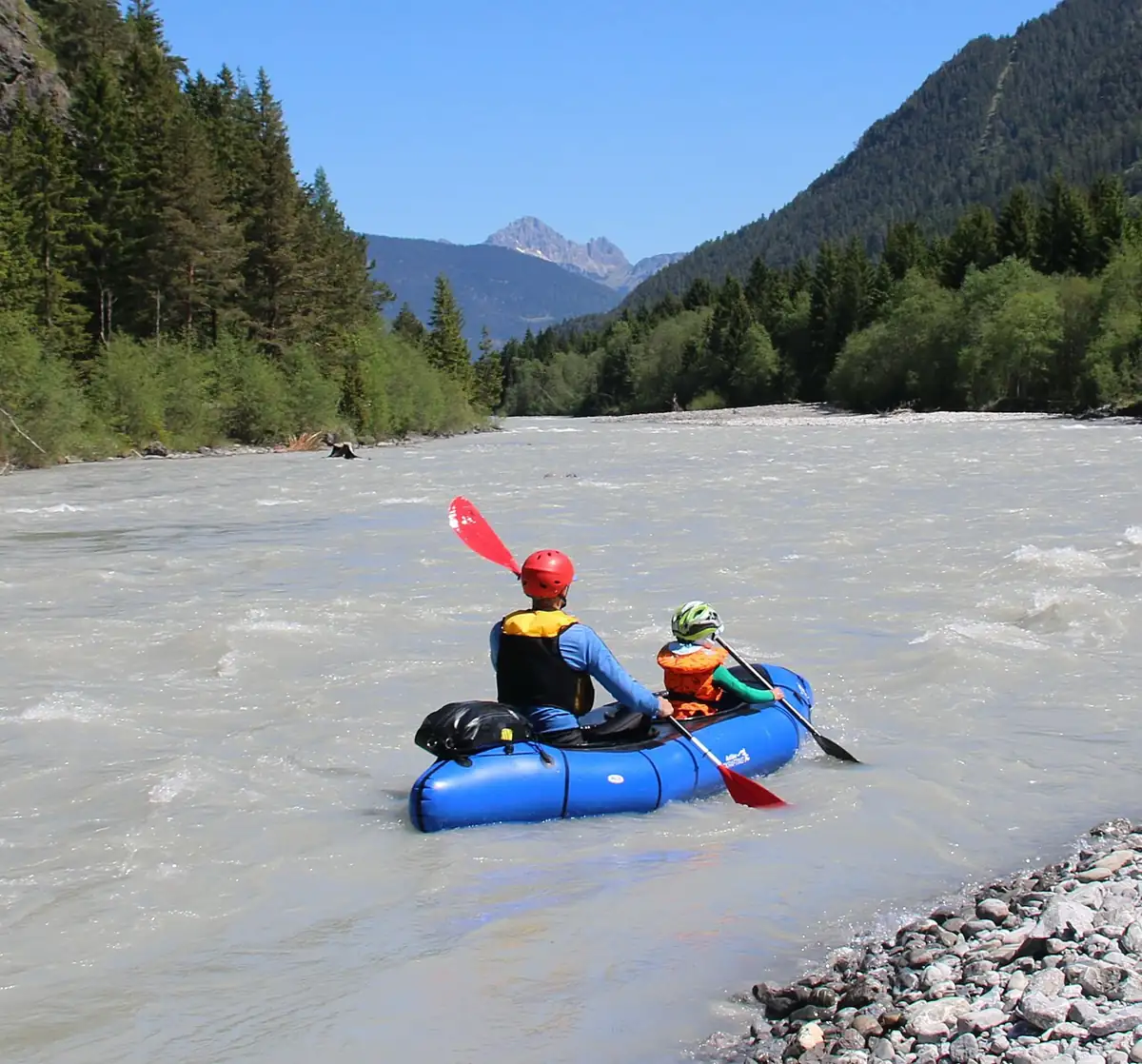
Children and small adults often paddle better in a small boat, or as a passenger in a tandem, than lost in an adult-sized cockpit. Proper life jackets matter more than boat size; the life jacket guide covers fitting one.
A child in an oversized boat cannot reach the bow and has trouble getting the paddle into the water over wide tubes. Short paddles help, and so does packing the bow with a dry bag so small legs have something to push on. Growing kids may move up a size every couple of seasons, which is one reason many families start with rentals or used boats. More boat options are listed in the packrafts hub.
Should I size up or down if I am between sizes?
Usually up. A slightly long cockpit can be padded with a bolster or dry bag, but a short one cannot be made longer.
Can I go by my height alone?
Height is a starting point. Leg length, torso length and flexibility all change fit, so check the cockpit length against your own measurement.
Does a bigger boat carry more gear?
Larger sizes generally have more volume and capacity. Check the maker's load figure rather than assuming, and leave room to spare.
Do whitewater boats fit differently?
They are usually set up for a snugger fit, with thigh straps and foot bracing, so you can control the boat with your body in rapids.
What if two people of different heights share one boat?
Size it for the taller person and keep a foot bolster or stuff sack in the boat for the shorter one.