Boats · backcountry
Ultralight and lake packrafts
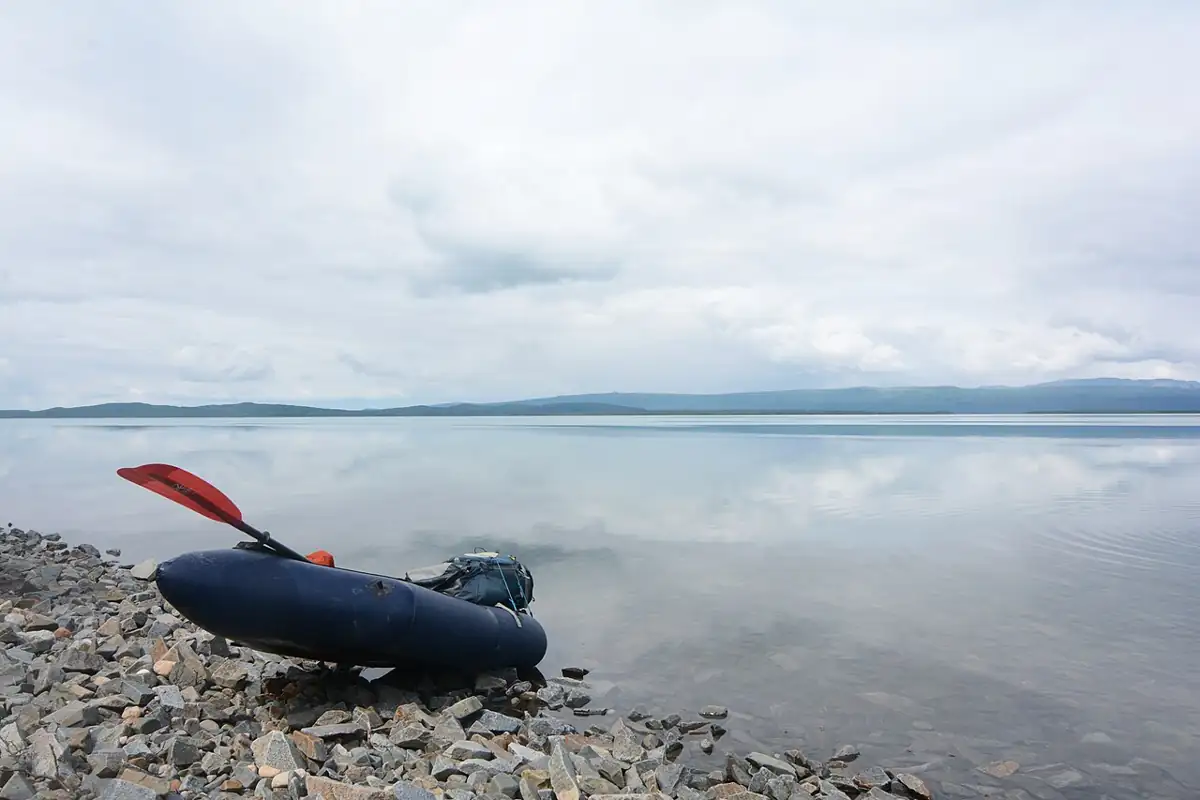
The lightest packrafts weigh a few pounds, light enough to carry on routes where a heavier boat would get left at home. They also have clear limits.
Last checked November 2026
Ultralight packrafts are designed around weight first. A thru-hiker crossing a few lakes, or a hunter heading deep into roadless country, can carry a boat of a couple of pounds for days without much complaint. On those trips the boat is a tool for getting across water, and the walking is the main event.
Putting weight first shapes every part of the design, and it rules out a lot of water that heavier boats handle fine.
Where the weight goes
A full-featured packraft can weigh 7 to 10 lb or more. Ultralight models commonly fall somewhere around 2 to 4 lb. Designers get there by:
- using lighter-denier coated nylon for the tubes and often the floor (the page on fabrics and seams explains how denier relates to toughness)
- shrinking the tubes and shortening the hull, which saves material but costs buoyancy and legroom
- cutting fittings down to a few D-rings and simple valves, with no thigh strap points or cargo zipper
- leaving off the deck, or offering a light one as an option
The whole system, not just the boat
The number on a spec sheet is usually the bare hull. What you carry is the boat plus everything that makes it usable. Before you compare boats, list the full system and weigh your own pieces on a kitchen scale.
| Item | Lighter choice | Heavier choice | What to think about |
|---|---|---|---|
| Hull | Thin fabric, small tubes, no fittings | Heavier floor, larger tubes | Most of the weight, and most of the durability |
| Seat | Thin inflatable or a foam pad you already carry | Thick inflatable seat with backrest | A sleeping pad can double as a seat |
| Deck | None, or a light cruiser deck | Whitewater skirt | Skip it only for warm, calm water |
| Paddle | Light four-piece shaft, small blades | Heavier shaft, larger blades | A flimsy paddle tires you on long crossings |
| Inflation | Small inflation bag | Bag plus pump | The bag can also serve as a dry sack |
| Life jacket | Low-profile inherently buoyant vest | Full whitewater vest | Never leave it out to save weight |
| Repair kit | Tape and a few patches | Full glue kit | Carry at least enough to fix a puncture |
Once the hull is light, the extras can add up to more than you saved on it. A light boat with a heavy paddle and a full whitewater vest can end up close to a mid-weight touring setup. The full packrafting packing list covers the other items you will want on a multi-day trip.
What you give up
Thin floors puncture and wear through more easily. On shallow, rocky rivers you will be patching more often, so carry a repair kit and learn the basics on the packraft repair page.
Short boats with small tubes spin and wander. On a windy lake you can spend much of your effort just keeping the bow pointed, and a clip-in tracking fin helps on flatwater.
Load matters more in a small boat. A heavy pack on the bow lowers the freeboard and makes the boat wet and sluggish, so check the stated capacity against your body weight plus a full pack, and leave some margin.
Most ultralight boats are not built for real rapids. Waves that a whitewater design would ride over can swamp or flip them.
Where a light boat is a bad idea
Light boats get people into trouble mostly when they end up on water they were never meant for. Leave the ultralight boat at home, or rethink the route, in these situations.
- Rivers with continuous rapids. A small, open boat fills and flips in wave trains that a larger boat would ride over. Check how the river is graded and what the current flow means using a guide to gauges and flows before you commit.
- Big cold lakes in wind. A long crossing in a slow, light boat leaves you exposed for a long time. If the wind rises halfway across, you may not be able to make progress. Stay close to shore, or wait for calm.
- Shallow rocky rivers on long trips. Thin floors wear through on rocks and gravel, and repeated patching eats into your time and supplies.
- Very heavy loads. Hunters packing out meat, or bikerafters carrying a bike on the bow, often exceed what a small boat can safely carry. The bikerafting setup guide covers why larger boats are usual for that.
- Remote rivers with no easy walk-out. If a failed boat means a multi-day walk through rough country, a more durable boat is worth the weight.
- Cold snowmelt water without proper clothing. A small boat sits low, takes on splash, and offers little shelter. Read the cold-water safety guide before trips where a swim would be dangerous.
Who it suits
| You probably want an ultralight boat if | You probably do not if |
|---|---|
| The boat is a small part of a long hike | The river is the main event |
| Water is mostly flat or slow | You expect Class II+ rapids |
| You will carry it for days | You put in near the car |
| You weigh less, or pack light | You are tall or carry heavy loads |
Tall or heavy paddlers should be extra careful about size, since small boats leave little room. The guide to packraft sizing covers how to check cockpit length and capacity.
Worked example: a hike with lake crossings
Picture a week-long backpacking route through high lake country, with two or three lake crossings that save long detours around the shore, and one slow river section.
- The water is flat and the river is slow, so a light boat suits the route.
- The pack is heavy at the start of the week with food. Check that the boat's capacity covers your body weight plus that load with room to spare.
- Crossings are planned for early morning, when wind on mountain lakes is often lighter. Each one stays close enough to shore that a swim would be short.
- The seat is the sleeping pad, the inflation bag doubles as a pack liner, and the repair kit is tape plus a couple of patches.
- The paddle is a light four-piece model, and a light life jacket rides on the outside of the pack.
Take the same boat onto a whitewater trip, or a big lake in an afternoon wind, and the weight saving stops being worth it.
Paddle and inflation choices
A pound saved on the boat goes further if the rest of the kit is light too. Light four-piece paddles and compact inflation bags help. See the pages on choosing a packraft paddle and on inflation bags and pumps for options.
Caring for a thin boat
Light fabric needs gentler handling. Carry the boat over rocky landings rather than dragging it. Clear sharp sticks and stones before you set it down on shore. Keep it out of direct sun when you are not paddling, and pack it so that buckles and trekking pole tips cannot rub through the fabric. Inspect the floor after each trip and patch small wear spots before they turn into holes.
The other boat types are summarized in the packraft design guide.
How light can a packraft be?
The lightest boats weigh roughly 2 lb or a little more without seat or deck. Most ultralight models fall somewhere around 2 to 4 lb.
Can an ultralight packraft handle rapids?
Easy moving water and small riffles, yes. Real rapids are a bad match, because the small open boat swamps and flips more easily than a whitewater design.
Are ultralight packrafts less durable?
Yes. Thinner fabric punctures and wears through more easily, especially on the floor. Careful handling and a repair kit make up for some of that.
Do I need a spray deck on an ultralight boat?
On warm, calm water many people go without. For cold or windy crossings, a light deck keeps you warmer and drier for little extra weight.
What is the biggest mistake with ultralight packrafts?
Taking them on water they were not built for, such as continuous rapids or long, windy lake crossings, or overloading them with heavy packs.