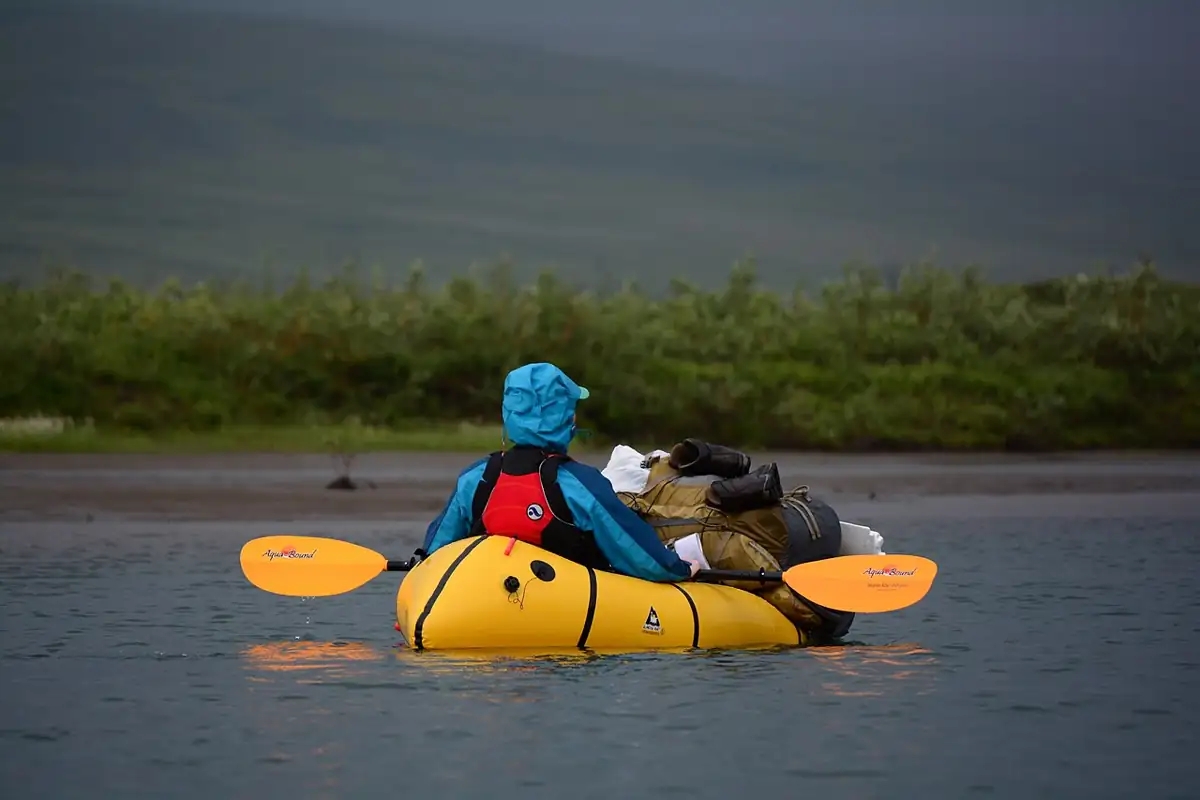
Gear · paddles
Choosing a packraft paddle
You hold the paddle for every stroke of every trip. Length, blade size and the type of joint decide how it feels after a long day.
Last checked November 2026
A packraft sits low and wide, and you sit on the floor of it. That makes a packraft paddle a different tool from a sea kayak paddle. It has to reach past fat tubes, its blade has to suit both the water and your shoulders, and its joints take sand, grit and a week stuffed in a pack.
Why four pieces
Almost every packraft paddle breaks down into four sections: two blades and a shaft split in the middle. Broken down, the pieces fit inside a 40 to 60 liter pack or strap to its side without catching on brush. Two-piece paddles are stiffer and simpler, but at full blade length they stick out above your head on the hike. For trips with real walking, most people carry four pieces.
Paddles differ most at the joints. Push-button ferrules are light and quick, though sand collects in them and they can develop a little play over time. Lever-lock or clamp-style joints let you set length and feather in small steps and usually stay tighter. Whatever you choose, rinse the joints after silty rivers and never force a gritty joint together.
Two, four or five pieces
| Pieces | Packed length | Strengths | Weak points |
|---|---|---|---|
| Two | Half the paddle, often over 100 cm | Stiffest, fewest joints to fail | Awkward on a pack, snags brush |
| Four | Roughly 55 to 65 cm per section | Fits inside most packs, adjustable length | Two more joints to keep clean |
| Five or more | Shorter still | Good for bike frames and small packs | More flex, more play, more parts to lose |
Four pieces is the default because it balances packability against stiffness. Five-piece designs exist mainly for bikerafting and very small packs. If you plan to strap the paddle to a frame bag, the bikerafting setup guide covers where the sections ride.
Length
Paddle makers size packraft paddles mainly by the width of the boat and the kind of paddling you do. Your height matters less than in a sit-on-top kayak, because in a packraft you sit at the same low level whatever your size. As a starting point, published sizing guides cluster around these figures:
| Boat and use | Typical starting length |
|---|---|
| Narrow solo boat, whitewater | About 195 cm |
| Average solo boat (roughly 36 to 38 in wide), whitewater | About 197 to 200 cm |
| Wider solo boat, whitewater | About 205 cm |
| All-purpose mix of river and flatwater | About 205 cm |
| Long-distance touring and lakes | About 210 cm |
| Tandem boat, low seat | About 220 cm |
| Wide tandem, high seat or heavy load | Up to about 240 cm |
Use those numbers as a starting range and test from there. Adjustable shafts usually give you 10 to 15 cm of play, which covers most of the gap between whitewater and touring use. If you fall between two lengths, shorter paddlers tend to prefer the shorter option.
The sit test
- Inflate the boat to your normal pressure and sit in it on flat ground or calm water, wearing your usual PFD.
- Set the paddle to the middle of its range and hold it with your hands a little wider than your shoulders.
- Take a few forward strokes. If your knuckles or the shaft hit the tubes, lengthen the paddle.
- Watch your top hand. If it rises above eye level on a normal stroke, shorten the paddle.
- Do a few sweeps and a draw. The blade should bury fully without you leaning far out over the tube.
- Mark the setting you like with tape or a scratch on the shaft so you can find it again.
Your seat height changes the answer. An inflatable seat or a firm backband lifts you a few centimeters, which often lets you run a slightly shorter paddle. Boat width plays into it too: the page on choosing a packraft size explains how tube diameter and inner width differ between models.
Blades and shafts
| Choice | Lighter, smaller option | Bigger, stronger option |
|---|---|---|
| Blade size | Touring blade, easier on shoulders over long days | Whitewater blade, more bite for ferry angles and boofs |
| Blade material | Fiberglass or carbon, light and stiff | Reinforced nylon, heavier but tolerant of rock hits |
| Shaft | Carbon, lightest and warmest in the hand | Fiberglass or aluminum, cheaper and more forgiving |
| Feather | 0 degrees, simple for beginners | 30 to 60 degrees, less wind drag on the top blade |
Plenty of paddlers settle on a mid-size blade. A smaller one lets you hold a steady cadence on lakes and long canyon floats without sore elbows, while on rocky creeks a bigger blade grabs water fast when the boat has to move right now.
Materials compared
| Material | Weight | Stiffness | Durability on rock | Feel in cold weather |
|---|---|---|---|---|
| Aluminum shaft | Heaviest | Moderate | Dents but rarely snaps | Cold to hold, wear gloves |
| Fiberglass shaft | Medium | Good, with some flex | Good | Comfortable |
| Carbon shaft | Lightest | Very stiff | Can crack from a hard point impact | Warmest |
| Nylon or plastic blade | Heavy | Flexes under power | Very good, edges scuff | Neutral |
| Fiberglass blade | Medium | Stiff | Good, edges chip over time | Neutral |
| Carbon blade | Lightest | Stiffest | Edges can chip on sharp rock | Neutral |
A stiff carbon paddle puts all your effort into the water. On flatwater that feels good; after eight hours your wrists may disagree, and a little flex is easier on joints. For shallow, rocky rivers where you push off stones, a nylon or reinforced blade takes abuse better than a thin composite edge.
Blade shape
Wide, short blades catch water quickly and suit whitewater, where you need a strong stroke in a short time. Long, narrow blades load more gently and suit steady touring. Most packraft blades are symmetrical and slightly spooned. A dihedral (a ridge down the face) helps the blade enter cleanly and reduces flutter at low effort.
Feather, explained
Feather is the angle between the two blades. At 0 degrees the blades line up, so you never rotate the shaft. With feather, the top blade slices through the wind edge-first while the bottom blade pulls, and your control hand twists the shaft a little on every stroke. Feathering helps on windy lakes and long open stretches. It also adds wrist motion, and some paddlers with wrist or elbow trouble go back to zero for that reason. A packraft spins more readily than a kayak, so the wind saving is small, and switching angles between trips costs you more than any setting gains. Pick one angle, mark it on the shaft, and keep it.
Spares and leashes
On a remote trip, a lost or broken paddle can mean a long walk out. Groups often carry one spare breakdown paddle shared between boats, or each paddler carries a spare blade. Paddle leashes are popular on lakes and in wind, but in moving water a leash is an entanglement hazard. If you use one on flatwater, unclip it before the first rapid.
A practical spare policy by trip type:
- Local day float with roadside access: no spare needed, since a lost paddle means a walk along the bank.
- Overnight in a canyon with walk-out options: one spare blade or one shared paddle per group of three or four.
- Remote multi-day trip or open water: one full spare paddle per group, stored where you can reach it without unpacking the bow.
Worked examples
A solo whitewater setup
You paddle an average-width whitewater boat on Class II and III rivers in Colorado. A paddle around 200 cm with a mid-size or whitewater blade, a fiberglass or carbon shaft, and 0 degrees of feather is a sensible place to start. Clamp-style joints that hold tight under load will feel more solid in hard strokes. The page on what makes a whitewater packraft explains how the boat side of that setup works.
A tandem lake and river trip
Two paddlers in a tandem boat, sitting low, on a mix of lake crossings and gentle river. Each person often runs about 220 cm, longer if the boat is wide or loaded. A touring blade keeps the cadence sustainable across hours, and some feather may help on an exposed lake. The tandem packraft guide covers seating and trim in two-person boats.
Common mistakes
- Buying a fixed-length paddle before testing length in your own boat.
- Picking a huge whitewater blade for long touring days, then nursing sore shoulders.
- Carrying a gritty push-button joint without rinsing it; it eventually seizes or wobbles.
- Changing feather angle between trips, so the control hand never learns it.
- Leaving a leash clipped on in moving water.
- Storing the paddle assembled in a hot car, which can deform composite joints over time.
Care
Rinse the paddle in fresh water after a trip, dry the joints, and store it out of direct sun. Check blades for cracks along the edges, and file down burrs on aluminum shafts so they do not cut your hands or your dry bags. A drop of silicone-free lubricant on a sticky button can help, but wipe off the excess so it does not hold sand. The general advice on cleaning and storing your gear applies here too.
How the paddle fits the rest of your kit
Your paddle length depends on your seat height, so if you add an inflatable seat or a backband, test the length again. The forward, sweep and draw strokes are easier to learn with a paddle sized for you. The gear overview lists the rest of the system, and the next page covers getting air into the boat. Add the paddle and any spare to your trip packing list so the blades do not stay behind in the car.
What length paddle do I need for a packraft?
Most solo packrafters land between about 197 and 210 cm, shorter for whitewater and longer for touring; tandem paddlers often use around 220 cm. Test in your own boat.
Can I use a kayak paddle in a packraft?
Yes, if it is long enough to clear the tubes. Most kayak touring paddles fall in a usable range, but a one-piece or two-piece paddle is awkward to carry on a hike.
Is carbon worth it over fiberglass?
Carbon saves weight and feels warm in the hand, which matters on long trips. Fiberglass costs less, flexes a little more and tolerates hard impacts slightly better.
Should I feather my packraft paddle?
Zero feather is a fine default. Try 30 to 45 degrees if you paddle into wind often, then keep whatever you choose.
Do I need a spare paddle?
On day trips near a road, usually not. On remote or multi-day trips, carry at least one spare per group.