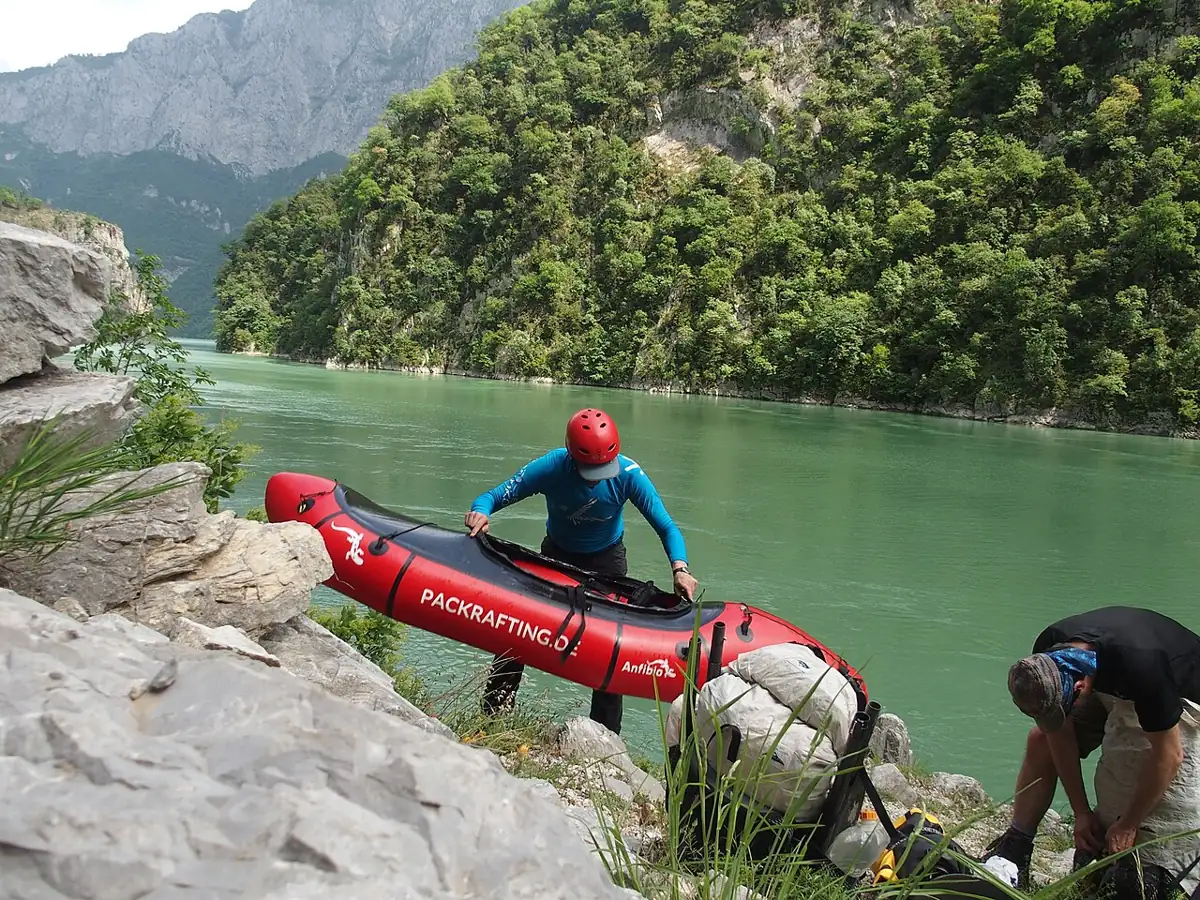
Gear · inflation
Inflation bags, pumps and topping off
A packraft runs at low pressure and still needs to be firm. How the common inflation tools and valves work, and how to manage air as the day warms and cools.
Last checked November 2026
Packrafts are low-pressure boats: a large volume of air at very little pressure. Most of that volume goes in quickly with a bag, and the last bit of firmness comes from a few breaths or a top-off at the end. Too little air and the boat flexes in waves; too much, left sitting in desert sun, and the seams and valves take the strain.
The inflation bag
Most packrafters use an inflation bag, a lightweight nylon sack, open at one end, with a threaded nozzle at the other that screws onto the boat's valve. It weighs a few ounces, packs into a pocket, and works as a stuff sack on the hike in.
- Lay the boat flat, open the valve, and screw the bag's nozzle into it.
- Hold the bag open and swing it through the air, or face it into the wind, so it fills.
- Twist or roll the open end shut to trap the air.
- Squeeze and roll the bag toward the boat to push air in.
- Repeat until the bag stops emptying easily, usually after 10 to 20 fills depending on the boat.
- Remove the bag, close the valve, and top off by mouth until the tubes are firm.
Keep the inside of the bag clean. Sand that gets in tends to end up in the valve, where it can stop the seal from closing.
Getting more from each fill
Each fill goes faster if you scoop a lot of air quickly. In still air, hold the mouth wide and pull the bag toward you in one long sweep, or run a few steps with it held open. In a breeze, face the opening into the wind and let it fill on its own. Close the end with two quick twists before air leaks back out, then press the bag against your thigh or the ground and roll it down toward the nozzle. A bag usually gets a boat to roughly 80 to 90 percent of full firmness. The rest comes from your lungs or a pump.
Some bags double as a dry bag or a pack liner. That saves weight, but a bag full of sleeping bag cannot inflate the boat until you empty it, so think about the order you pack at camp. If you strap the boat to a bike, a bag that rolls small earns its place in a frame bag; the bikerafting setup guide covers what else rides on the bike.
Valve types
You will meet several kinds of valve on packrafts. Bags and pumps attach by a thread or a push-fit, so check that yours match before the trip.
| Valve style | How it works | Inflating | Deflating | Watch for |
|---|---|---|---|---|
| Twist or screw-open valve | A threaded collar opens and closes a wide port | Bag screws on directly | Open fully for fast deflation | Grit on the thread and seal |
| One-way push valve | Spring-loaded center lets air in, holds it when you stop | Bag, pump or mouth with no backflow | Press and twist to lock open | Debris holding the flap open |
| Two-part cap valve | Inner one-way flap plus an outer cap | Air goes in through the flap | Unscrew the whole base | Losing the cap, cross-threading |
| Top-off tube or mouth valve | Small separate port for breath top-ups | Mouth only, from the seat | Rarely used for deflation | Bite valves can wear |
The anatomy guide shows where valves sit on a typical boat. Boats with a cargo zipper add one more seal to think about: the zip must be fully closed and clean before you inflate, or air bleeds out through it. See the page on cargo zippers and inside-tube storage for how that seal works.
Topping off
Most packraft valves let you add air by mouth with the valve open or in a one-way setting, depending on the design. Some boats come with a short inflation tube so you can top off from your seat without putting your face on the valve. Press your thumb into the tube to test it; it should dent only slightly. A soft boat folds in waves, steers poorly and wears faster.
How firm is firm enough
Many manufacturers point to a working pressure around 1.5 psi, and the ranges in owner's manuals run from a little over 1 psi up to about 2 psi. Very few paddlers carry a gauge, so the thumb test does the work. A well-filled tube dents slightly under a firm thumb and springs back at once. If you can pinch the tube fabric between finger and thumb, it is soft. If it feels as hard as a car tire, let a little out, especially before the boat sits in the sun.
Electric mini pumps
Small rechargeable pumps can fill a packraft in a minute or two and deflate it for packing. They earn their place at car-based put-ins, on trips with many inflations, and for paddlers who find the bag tiring. You will still top off by mouth or with a hand pump, since most of these pumps cannot reach full firmness, and the battery and its charging port need to stay dry.
| Method | Weight | Best for | Drawbacks |
|---|---|---|---|
| Inflation bag | A few ounces | Every trip, especially long walks | Slow in still air, needs technique |
| Mouth only | Nothing | Top-ups on the water | Tiring for a full fill |
| Rechargeable pump | Several ounces plus charging | Frequent inflations, shuttles | Battery, cannot finish the job |
| Small hand pump | Heavier than a bag | Reaching full pressure, cold mornings | Bulk in the pack |
| Large hand or foot pump | Heavy | Home or car camping | Too bulky for most trips |
Choosing a pump
- Check the nozzle fits your valve, or carry the adapter the pump needs.
- Look at how the pump charges. A USB-C pump can share a power bank with a phone or a satellite messenger.
- Store it in a small dry bag. Water in the motor or the charging port is the usual way these pumps die.
- Expect noise. At a quiet put-in or wilderness campsite, the bag is the more polite tool.
- If you want the last bit of firmness without getting dizzy, a small hand pump does it better than an electric one.
Temperature and pressure
Air contracts when it cools. If you inflate on a warm beach and then launch onto a snowmelt river, the boat will soften within minutes. Put in, let the tubes cool, then top off. A firm boat left on hot rocks in full sun goes the other way and builds pressure. On hot days, keep the boat in the shade, splash water on the tubes, or let a little air out during long breaks.
Why the change is so large
A packraft holds only a pound or two per square inch above the surrounding air, while the air itself presses at almost 15 psi. When the air inside a tube cools by a few tens of degrees, its pressure drops by a few percent of that total. A few percent of 15 psi is roughly the whole working pressure of the boat. That is why a boat pumped firm on a hot beach can feel half-empty after five minutes on cold water, and why a boat that felt fine at dawn can turn drum-hard on a hot sandbar by noon.
| Situation | What happens | What to do |
|---|---|---|
| Warm beach, cold river | Tubes soften soon after launch | Paddle a few minutes, then top off |
| Morning launch, hot afternoon | Pressure climbs through the day | Let some air out at lunch |
| Boat parked on dark rocks in sun | Pressure rises fast | Move to shade, cover or wet the tubes |
| Cold night at camp | Boat looks flat at dawn | Top off before loading, not before breakfast |
| High pass on a hike-in, low river | Small change from altitude alone | Temperature matters more; top off on the water |
Desert trips make the sun problem real. On rivers in the Utah canyon country, dark boat fabric on sand or slickrock in summer can get very hot to the touch. Repeated overpressure in heat and grit in the valve wear out seams and seals sooner than age alone.
Deflating and packing
Open the valve fully and let the boat sag, then roll it toward the valve from the far end, pushing air out as you go. A rechargeable pump with a suction setting gets the last air out and makes the roll tighter. Fold, do not crease hard on the same lines every time; the care and storage guide covers rotating folds and drying the boat before long storage. Keep the inflation bag rolled around something it will not lose, or clip it to the boat, so it does not stay behind on a sandbar.
Common mistakes
- Inflating hard on a hot beach and never letting air out when the boat sits in the sun.
- Topping off before launch and not again after the tubes cool on the water.
- Leaving the bag's nozzle in the sand while you load, then screwing grit into the valve.
- Carrying a pump with no adapter for your valve.
- Forgetting that a cargo zipper must be shut and clean before you start filling.
For a full walk-through of setup at the water's edge, see inflating a packraft step by step. The gear and accessories overview covers the rest of the kit. Put the bag on your trip checklist, since it is easy to leave in the car, and read about stowing gear in dry bags next.
How much pressure does a packraft need?
Many makers suggest about 1.5 psi, with manuals ranging from a little over 1 to about 2 psi. Follow your boat's stated maximum and use the thumb test on the water.
Can I fill a packraft with just my lungs?
You can, but it takes a long time and leaves you lightheaded. Use a bag or pump for the bulk and your lungs only for the final top-off.
Why does my boat go soft right after I launch?
The air inside cools in the river and contracts. Paddle for a few minutes, then top off.
Is an electric pump worth carrying?
On trips with many inflations or road access, often yes. On long hikes, most people leave it home and use the bag.
Can I use a car tire pump?
Avoid it. Tire pumps work at far higher pressures and can overinflate a packraft in seconds.