Gear · checklist
Packrafting packing list
Forgetting a paddle blade or a valve cap can end a trip at the trailhead. Run through these lists before every outing and adjust them to the river.
Last checked November 2026
A packrafting load is a backpacking list and a paddling list stuffed into one pack, and things get forgotten where the two overlap. Items here are grouped by job, with columns running from a short day float to a remote multi-day trip. Mark it up for your own boat and rivers; nobody needs everything on it every time.
Start with the core lists by category, then add the extras from whichever trip checklist fits: a warm-weather day float, a multi-day desert river or a cold whitewater day.
Boat and paddle
| Item | Day trip | Overnight | Remote trip |
|---|---|---|---|
| Packraft with valve caps and seat | Yes | Yes | Yes |
| Four-piece paddle | Yes | Yes | Yes, plus a group spare |
| Inflation bag or small pump | Yes | Yes | Yes |
| Straps for the bow load | Yes | Yes | Yes, plus spares |
| Spray deck, backband or thigh straps | If the river calls for it | If the river calls for it | If the river calls for it |
For help choosing, see the guides to paddle length and blades and inflation bags and pumps.
Safety
| Item | Day trip | Overnight | Remote trip |
|---|---|---|---|
| PFD with whistle and knife | Yes | Yes | Yes |
| Helmet for rocky water | As needed | As needed | As needed |
| Throw bag | Group | Group | Group, often two |
| First aid kit | Small | Medium | Full, with blister and wound care |
| Map, river guide or GPS track | Yes | Yes | Yes, with a paper backup |
| Communication device | Phone in a dry case | Satellite messenger advised | Satellite messenger |
| Headlamp | Yes | Yes | Yes, plus spare batteries |
Carrying a PFD isn't enough if it rides up in a swim. A life jacket that fits snugly, worn zipped, is the one item you can't do without on any trip. Whether you need a whitewater helmet depends on the river grade and how rocky it is, so decide that when you check the river, not at the put-in.
Clothing
- River shoes that also hike, and dry socks for camp
- Drysuit, drytop or wetsuit matched to water temperature
- Synthetic or wool base layer and a warm fleece
- Rain jacket and a warm hat, plus sun hat and sunglasses with a strap
- Gloves or pogies for cold water
The page on dressing for cold water explains how to match these to the river. For the shoe itself, the footwear guide compares options for desert canyons, snowmelt and long portages.
Repair
- Adhesive repair tape for the boat, pre-cut with rounded corners
- Alcohol wipes and a small rag
- Small tube of urethane adhesive for longer trips
- Duct tape wrapped around a water bottle or paddle shaft
- Spare valve cap or seal if your boat uses them
- A few zip ties and a short length of cord
The packraft repair guide explains how to use them.
Camp and food
- Shelter, sleeping bag and pad, each in its own dry bag
- Stove, fuel, pot and lighter in a sealed bag
- Food for the planned days plus a spare meal
- Water filter or treatment
- Sunscreen, lip balm, insect repellent
- A bag to carry out trash, and a toilet kit where required
Checklist 1: warm-weather day float
A day on an easy river or lake in summer is the lightest kit you'll carry. The boat, paddle, PFD and inflation bag are the core, and almost everything else fits in a small dry bag strapped to the bow.
- Packraft, seat, valve cap, inflation bag
- Paddle (count the pieces)
- PFD with whistle
- Helmet if there are rocky rapids
- River shoes, sun hat, sunglasses with a strap
- Quick-dry layer and a light rain jacket
- Water, lunch and snacks
- Small first aid kit and repair tape
- Phone in a waterproof case, map or GPS track
- Sunscreen and a small towel
For most people this load lands somewhere in the range of 12 to 20 pounds including the boat, depending mostly on the packraft and paddle. If you hike in more than a few miles, that difference matters, and a lighter boat or inflation bag is where to save weight.
Checklist 2: multi-day desert river
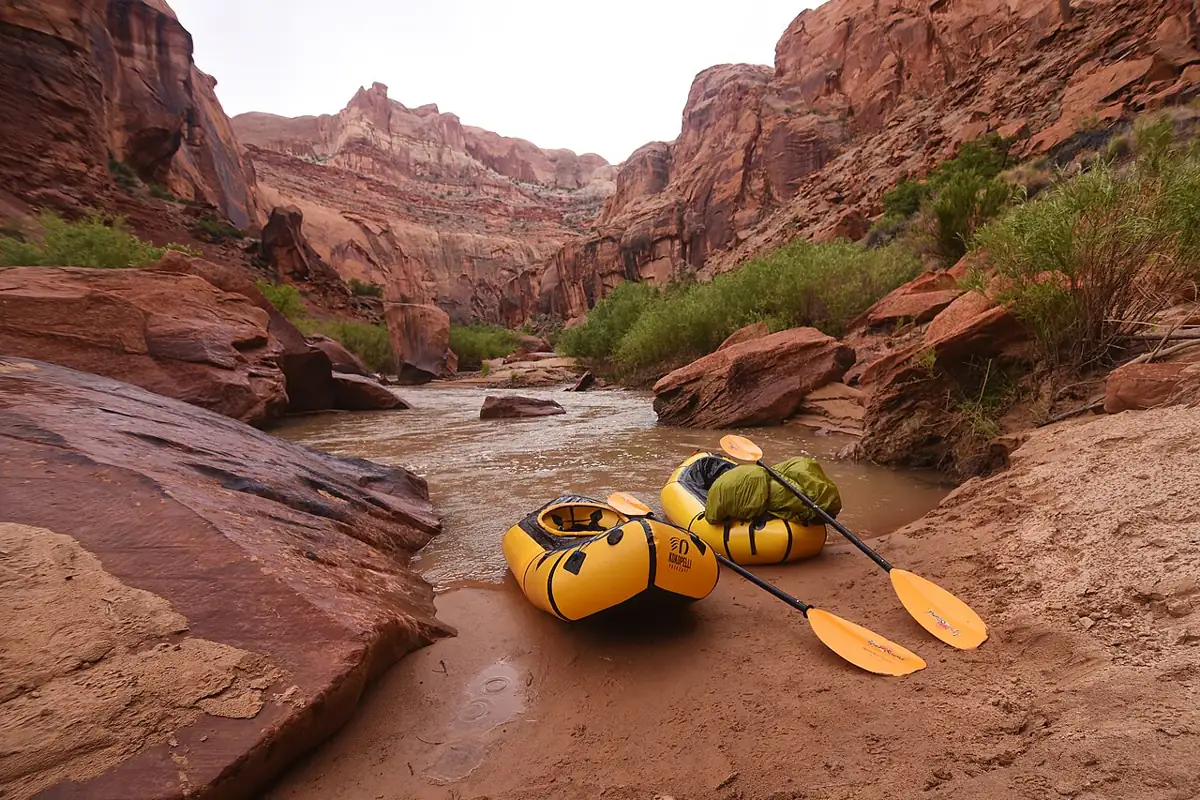
Slow desert rivers in Utah and Arizona are classic packraft overnighters, and they bring their own problems: sun, silt, heat, limited water sources and river rules on waste and fires. A good worked example is a two- or three-day float through Labyrinth Canyon on the Green River.
What to add for a desert trip
- Sun protection: long-sleeve sun shirt, wide-brimmed hat, buff, lip balm with SPF
- Extra water capacity, since some desert rivers carry so much silt that filters clog fast; a settling bucket or bag, or a prefilter, helps
- A portable toilet system and a fire pan if the managing agency requires them
- A ground cloth or footprint for sandy camps
- Shade options for midday, such as a tarp
- Gaiters or neoprene socks to keep sand out of your shoes
- Permit printout and any required paperwork
Worked example: a two-day Labyrinth Canyon float
The Labyrinth Canyon section of the Green River is managed by the Bureau of Land Management, and noncommercial trips need a free BLM permit that the trip leader carries on the river. The permit stipulations require you to carry and use a fire pan and an approved portable toilet. Check the current permit form and rules on the BLM Labyrinth Canyon page before you go, and note that trips continuing into Canyonlands National Park need a separate park permit.
For a two-day packraft trip, that turns into a checklist like this:
- Download and submit the BLM permit, and print a copy for the trip leader.
- Arrange the shuttle or pickup at your take-out well ahead; the river doesn't loop back.
- Pack the core boat, safety and camp lists from above.
- Add a group portable toilet and fire pan, shared and strapped to bows.
- Plan water: carry several liters each and a way to settle and filter silty river water.
- Pack for heat by day and cool nights, especially in spring and fall.
- Check the river flows and gauge readings the week before, since the Green is big water even when it looks calm.
Expect a multi-day desert load, boat included, to fall roughly in the 30 to 45 pound range per person at the start, dropping as you eat and drink through it. Shared group items like the toilet and fire pan push individual loads up if your group is small.
Checklist 3: cold whitewater day
Spring snowmelt runs in Colorado and the northern Rockies combine cold water with harder rapids. The packing list shifts toward warmth and rescue gear, and the margin for leaving something behind shrinks.
| Item | Why it matters |
|---|---|
| Drysuit or drytop with dry pants | Protects against cold shock if you swim |
| Insulating layers under the drysuit | Warmth while paddling and after a swim |
| Neoprene hood or skull cap | Head heat loss in cold water |
| Pogies or neoprene gloves | Keeps hands working on the paddle |
| Helmet | Rocky rapids and the chance of a roll |
| Throw bag and rescue knife | Basic rescue kit on each paddler |
| Spare warm layer and hot drink in a dry bag | Rewarming after a swim |
| Thigh straps and spray deck | Boat control and staying dry, if you are trained to use them |
| Group first aid kit with emergency blanket | Treating cold or injured paddlers |
The drysuit, extra layers and rescue gear add up, and a cold-water day kit usually lands somewhere around 20 to 30 pounds with the boat. Read the cold-water safety guide before your first snowmelt trip; it explains why the first minutes in cold water are the most dangerous.
Weight ranges at a glance
Treat these as broad ranges. Your own numbers will move with your boat, how much water you have to carry, and whether you share group gear.
Common packing mistakes
- Packing the PFD at the bottom of the pack, then needing it first.
- Forgetting the valve cap or leaving the inflation bag in the car.
- Carrying gear in stuff sacks instead of real dry bags, then swimming.
- Bringing too little water on desert rivers because "it's a river trip".
- Packing cold-weather layers for the hike but not for a swim.
Last checks at the trailhead
Before you leave the car, make sure you have all four paddle pieces, the valve cap, your PFD and the inflation bag. Those get left behind most often, and you cannot improvise any of them in the backcountry. The gear section has a page on each.
FAQ
How heavy is a typical packrafting kit?
It varies a lot. A warm day float can be around 12 to 20 pounds with the boat, while a multi-day trip with camp gear, food and water often runs 30 pounds or more.
Do I need a satellite messenger?
On a short day trip with cell coverage you may not. On overnight and remote trips, or anywhere you could be stuck without signal, it's strongly advised.
What gets forgotten most often?
Paddle pieces, valve caps, the inflation bag and the PFD. Check those four at the car.
Should I pack the same for every river?
No. Use the core list, then add what the trip needs: desert trips add sun and water gear and sometimes required toilets, cold rivers add drysuits and rescue gear.
How do I keep my gear dry?
Use proper dry bags for anything that must stay dry, close them correctly, and strap them securely to the boat or pack them inside the tubes if your boat has cargo zippers.