Skills · river grades
River difficulty classes
Guidebooks and trip reports grade rivers on a six-step scale. Here is what each grade means, what it asks of you and your boat, and why you still judge the river on the day.
Last checked November 2026
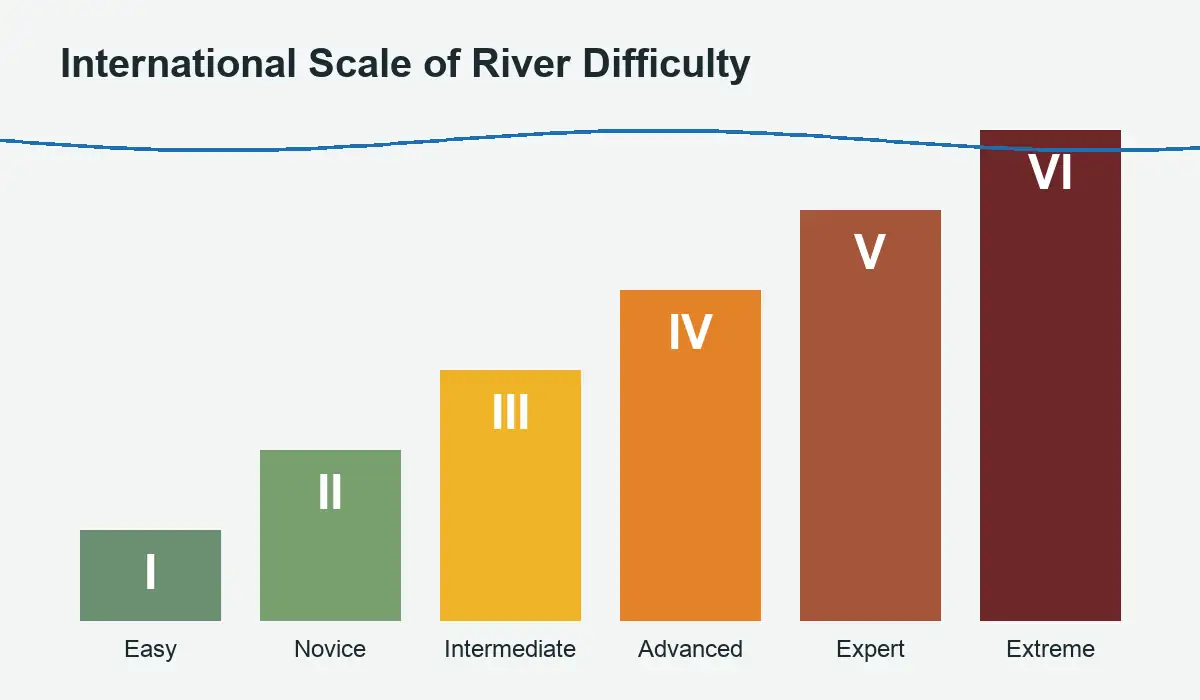
In North America, rapids and river sections are graded on the International Scale of River Difficulty, the version maintained by American Whitewater in its safety code. It runs from Class I to Class VI. Each step up means more obstacles, more powerful water, less time to react and worse consequences if you swim. Guides often add a plus or minus (Class II+, Class III-) to show a rapid sits near the edge of a grade.
The code itself calls the scale a rough guide for judging what gear, planning and skill a run needs, and says plainly that it is not exact. Rivers do not always fit one category, and regional habits shape how grades get assigned. The current edition of the American Whitewater Safety Code is free to read and worth a look before your first season on moving water.
The six classes
| Class | Name | What you see | Packraft notes |
|---|---|---|---|
| I | Easy | Moving water with riffles and small waves, few obstacles, all obvious | Good first river; self-rescue is easy |
| II | Novice | Straightforward rapids with wide, clear channels, some maneuvering, rocks and medium waves easily missed | Comfortable for a trained beginner; an open boat may take on water |
| III | Intermediate | Irregular waves that can swamp an open boat, complex maneuvers in fast current, strong eddies and powerful current | Spray deck and thigh straps recommended; scouting often wise; swims can be long |
| IV | Advanced | Intense, powerful but predictable rapids needing precise boat handling; large unavoidable waves and holes; must-make moves | Experienced packrafters only, with a solid roll or reliable self-rescue and a skilled group |
| V | Expert | Extremely long, obstructed or violent rapids; drops with big, unavoidable waves and holes; rescue is difficult even for experts | Expert paddlers with whitewater-specific boats and swiftwater rescue training |
| VI | Extreme and exploratory | Rarely run, very unpredictable and dangerous; errors can be fatal and rescue may be impossible | Treat as unrunnable |
The 2024 edition of the code adds a simple line about craft to each grade. Class I suits a wide variety of craft and Class II a wide variety of river-specific craft. From Class III up, it calls for whitewater-specific craft and equipment, and Classes IV and V add skilled or highly skilled groups. The same document warns that "recreational" rafts are not meant for Class III or harder water. For a packrafter, that line is a useful reminder that a light lake boat and a decked whitewater packraft are different tools, even if both are called packrafts.
What each grade asks of you
These are the skills to have before you paddle each grade, following the progression most courses teach.
| Grade | Boat handling | Rescue and swimming | Group and gear |
|---|---|---|---|
| I | Forward stroke, turning, stopping | Deliberate swim and re-entry in calm water | A partner, PFD, clothing for the water temperature |
| II | Reliable ferries, catching most eddies you aim for, clean wave trains | Defensive and aggressive swimming, catching a throw rope | Helmet, throw bag in the group, someone who knows the river |
| III | Precise lines in fast current, bracing with thigh straps, boat scouting | Self-rescue in long, pushy swims; throwing a rope accurately | Spray deck or self-bailer, group of three or more, a swiftwater course |
| IV | Must-make moves under pressure, a roll or very fast re-entry | Rescuing others, basic rope systems | Whitewater-specific outfitting, a strong team that has paddled together |
| V and up | Expert control in violent water | Advanced swiftwater rescue | A highly skilled group, often with a support plan on shore |
The strokes behind the boat handling column are on the stroke technique page, and the outfitting that makes Class III possible is covered under spray decks and self-bailing floors.
How to use the grade
A river section is usually graded by its hardest rapid, though some guidebooks list a range such as "Class II-III (IV)" where the number in parentheses is a single harder rapid or one you can walk. Read the description to find that rapid, how to scout it and whether a portage trail exists.
Grades also assume normal conditions. Several things push a river's real difficulty up:
- Cold water. The code asks paddlers to leave an extra margin between their skills and a river's rating when the water is cold. Older editions put a number on it, suggesting that a river below about 50 °F be treated as one class harder, and many paddlers still use that rule of thumb.
- Remoteness. A Class II rapid ten miles from a road has longer consequences than the same rapid next to a highway.
- Flow. High water can turn a Class II section into Class III or harder, and low water can create new rocks and pins.
- New wood. A single tree that fell last spring can make an easy rapid deadly. Grades do not track wood.
Reading a guidebook rating
Say a guidebook lists a day run as "Class II (III), best at moderate flows, one portage." Read it as three separate pieces of information. Most of the run is Class II. One rapid, the one in parentheses, is harder, and you need to know where it is and whether you can walk it. The flow note tells you the grade only holds within a certain range, so check the gauge and compare. The portage tells you there is a feature, often a dam or a log jam, that nobody runs. If you are comfortable on Class II and the Class III rapid has an easy walk around it, the run may suit you. If the harder rapid sits in a canyon with no way out, it does not.
How flow changes the class
Flow is the biggest single reason a river's real grade differs from its printed one. American Whitewater's code notes that difficulty can change with water level, downed trees, recent floods and weather, and that snowmelt rivers can run low in the morning and high in the afternoon.
| Flow compared with the guidebook range | Typical effect on difficulty | Packraft-specific concern |
|---|---|---|
| Well below | Can stay the same or get harder: more rocks, tighter lines | Pins and foot entrapment in shallow swims |
| Within the range | The printed grade applies | Normal line choices |
| Above the range | Often one grade harder or more; eddies wash out | Long swims, boats swamped in big waves, strainers in flooded banks |
| Flood stage | Unpredictable, often unrunnable | Debris, no eddies, rescue very hard |
Know the reading before you leave home. The guide to cfs and gauges shows how to find the right gauge, how to read the trend line and what a rising hydrograph means for the afternoon.
Packraft versus other boats
The scale was written with kayaks, canoes and rafts in mind and applies to packrafts unchanged, though boats within the sport handle the same water very differently. An open, lightweight lake boat fills quickly in Class II waves and becomes sluggish; a self-bailing or decked whitewater packraft stays light and maneuverable. A packraft is also easier to swim out of and re-enter than many hardshells, but it is light enough to be blown into holes and eddy lines that would barely move a raft. The page on whitewater packrafts explains the design features that matter as you move up the scale.
Packrafts also get carried to places other boats rarely reach, which ties straight back to the remoteness point above. A Class III creek at the end of a two-day hike is a much bigger commitment than the same grade beside a road, because help and a hike-out are far away. Many packrafters grade their own comfort zone down by a step on remote trips for this reason.
Moving up a grade
Plan on a full season or more at each step. A reasonable bar for moving up: you run the current grade cleanly, you have had swims there and handled them calmly, and you can rescue yourself and others in that water. Practice the strokes from the technique page, learn to recognize features on the whitewater reading guide and take a swiftwater course before your first Class III. For the trips in the Utah river guides, check which sections are flat water and which have rapids before you plan the days.
- Run the new grade first with paddlers who are comfortable on it and know the river.
- Pick a run where the harder rapids can be scouted and portaged.
- Choose a flow in the low-to-middle part of the recommended range.
- Pick warm water and good weather for the first few runs.
- Debrief after each trip: what went well, which swims or close calls happened, and why.
Courses speed this up. An instructor-led course gives you swims in controlled conditions and feedback on your lines. Wear a whitewater helmet from Class II upward, and treat cold water as a reason to wait for the next warmer month. The page on cold water explains why a swim in snowmelt changes the grade you can handle.
See the full list of skills articles.
What class of river can a beginner packraft?
Flat water and Class I to start, then Class II with experienced company once you can ferry, catch eddies and swim with confidence.
Is Class III too hard for a packraft?
No. Whitewater packrafts with thigh straps and spray decks or self-bailing floors run Class III and harder. The paddler needs the skills and the group needs rescue training.
What does a plus or minus mean?
Class III+ means a rapid at the hard end of Class III, close to Class IV. Class III- sits at the easy end. Some guidebooks use them, some do not.
Does cold water change the grade?
The printed grade stays the same, but the consequences of a swim go up sharply. American Whitewater's code asks for an extra margin of safety on cold, high or remote rivers.
Why does the same river have different grades in different guidebooks?
Grades are set by consensus and interpreted locally, and they depend on flow. Read the description, not only the number, and compare it with today's gauge reading.