Trip notes · Northwest Territories
Nahanni National Park Reserve
Most parties float the South Nahanni in canoes or rafts. Packrafts let a small team add a technical tributary and a climbing approach, at the cost of slow progress on the long flat miles.
Last checked November 2026
The South Nahanni River flows through Nahanni National Park Reserve in the southwest corner of the Northwest Territories. It cuts deep canyons through the Mackenzie Mountains and drops over Virginia Falls (Náįlįcho), which is much higher than Niagara. Most paddlers fly in by floatplane from Fort Simpson or nearby bases and float out to the community of Nahanni Butte. Parks Canada recommends that unguided parties have well-developed whitewater skills and years of experience.
Route overview
There are several standard starting points, each a floatplane drop on a lake or the river. Parks Canada estimates two to three days of paddling from Rabbitkettle Lake (Gahnįhthah Mįe) to Virginia Falls, and six to seven days from Island Lakes. Higher starts, such as Moose Ponds or the Little Nahanni headwaters, add whitewater and remoteness. The upper watershed lies partly in Nááts'įhch'oh National Park Reserve, also run by Parks Canada, so check which reserve's rules apply to your start.
| Start | What you get | Typical character |
|---|---|---|
| Flat Lakes (Little Nahanni) | A small, technical tributary before the main river | Rocky Class II-III, a tight canyon, harder drops to scout or portage |
| Moose Ponds | The full upper South Nahanni | Continuous rapids in the upper river, very remote |
| Island Lakes or Rabbitkettle Lake | Calm upper-river miles and hot-spring tufa mounds | Moving water, braided channels, a gentler start |
| Virginia Falls | The canyons only | Big-volume water, four main canyons, hot springs |
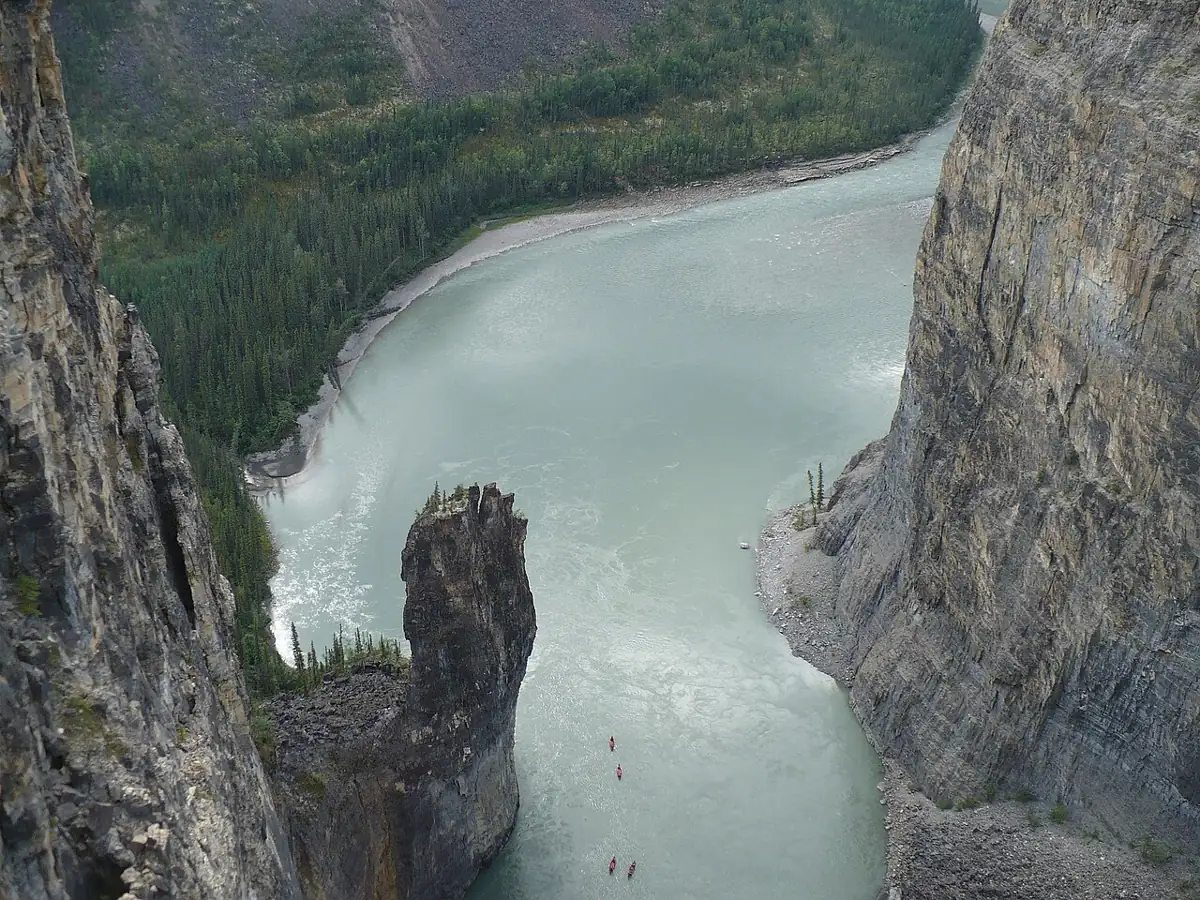
Below Virginia Falls the river runs through Fourth, Third, Second and First canyons, with walls approaching 1,000 meters in places, then braids out past Kraus Hot Springs and the Splits to Nahanni Butte. Parks Canada lists rapids up to Class III between the falls and Kraus Hot Springs. Distances quoted for the falls-to-Nahanni Butte section range from roughly 200 to 240 km depending on the source and the channel taken.
Reservations and rules
All overnight trips in the park reserve need a reservation, registration on entry and deregistration on exit, and every person pays a park-user fee. Arrivals at Virginia Falls are capped each day and stays at the falls campground are limited. Book early and confirm current rules with the Nahanni office.
Parks Canada currently allows 24 arrivals a day at Virginia Falls (12 private, 12 commercial) and a maximum of two nights at the falls campground. Reservations go first come, first served, and a reservation is only confirmed once every member's park-user fee is paid. You have 24 hours after entering the park to contact the office and register. The park sets these numbers and can change them, so check again in the season you plan.
- Reserve the trip with Parks Canada and arrange the floatplane.
- Practice rigging loaded boats on a local river before you fly.
- Register on entry and carry a satellite messenger.
- Portage Virginia Falls on the official trail.
- Deregister when you reach Nahanni Butte.
The Virginia Falls portage
The falls are the trip's one mandatory carry. The portage trail runs about 1.5 km, partly on boardwalk, and ends with a steep, narrow descent to the river below the falls. In a packraft this is easier than in a canoe: deflate or carry the boat on your back with the rest of the load, and expect one or two trips depending on how much food you still have.
Below the portage the river runs straight into Fourth Canyon and the big waves of Figure Eight Rapid. Packrafts are small in this water. Scout from shore, decide as a group whether to run or line, and set safety below.
Flows and season
The river is navigable roughly from June to September. Early summer brings high, silty snowmelt and cold water; by August the river drops and clears somewhat, but rain in the Mackenzie Mountains can raise it fast. The South Nahanni is a big-volume river even at moderate levels, with boils and eddy lines that can flip a light boat. Upper tributaries such as the Little Nahanni are much smaller and become rocky at low water.
There is no single gauge that packrafters use to plan the whole trip. Ask Parks Canada and your air charter about conditions before you fly, and keep enough spare days to wait out high water.
Hazards
- Cold, silty water and long swims in the canyons. A drysuit or full cold-water layering is standard, and you should read cold-water safety before you go.
- Big wave trains, boils and whirlpools in the canyons below the falls. A whitewater-capable packraft with thigh straps and a spray deck helps a great deal.
- Sharp shale and rock in the tributaries can tear tubes. Carry patches and adhesive and know how to use them; the repair guide covers field patching.
- Grizzly and black bears. Store food in bear-resistant containers and keep a clean camp.
- Remoteness. Help is days away even with a satellite messenger, and weather can ground aircraft.
A three-week trip with a climb in the middle
One three-person team that drove north to Fort Simpson split 22 days of food into bear-resistant bags. With climbing gear their packs weighed over 100 pounds each, just under the floatplane's limit. They landed at Flat Lakes, the headwaters of the Little Nahanni, with one experienced kayaker among them and no packraft experience at all.
It took two days to sort out rigging. Food bags strapped behind the seat gave back support and the big packs went on the bow, lashed on top so they could be cut loose in an emergency. Below the lake the creek grew into a rocky Class II-III run, then entered Crooked Canyon: two miles of deep, hard-to-scout water where sharp shale tore a small hole in one boat, patched in an eddy. At the final big hole, which many parties portage, one paddler punched through and two flipped, then ran it again without packs.
At the confluence they joined the silty South Nahanni, floated two easy days to a trailhead below the Ragged Range, cached boats and food, and hiked to Glacier Lake and the Cirque of the Unclimbables for an attempt on the Lotus Flower Tower that ended in a wet night on a ledge and a retreat. The second half was nine days on the South Nahanni: big wave trains, the portage at Virginia Falls, Pulpit Rock, and a last long day through braided channels to Nahanni Butte.
Logistics
- Most parties drive or fly to Fort Simpson and charter a floatplane. Plane weight limits are strict, so weigh everything in advance and confirm the limit with the operator.
- Trips usually end at Nahanni Butte, where the South Nahanni meets the Liard. From there, parties arrange a flight or boat pickup; some continue on the Liard to a road access point.
- Three weeks of food is heavy in a packraft. Plan resupply or caches with your air charter where allowed.
- Heavy boats handle differently, so practice before the trip. If you use cargo zippers, think through how you would get gear out after a capsize.
- Gravel bars and established sites are common; check Parks Canada's camping guidance for Virginia Falls and the hot springs, where rules differ.
Skill level and who it suits
This is an expert trip. Parks Canada asks unguided paddlers for years of whitewater experience, and packrafts add their own problems on big water: they are slow on flat sections, easy to flip in boils and hard to self-rescue fully loaded. It suits small, experienced teams who want to combine paddling with hiking or climbing, and who are comfortable reading big water from a small boat. If you are building toward it, spend a season on scouting and reading rapids and multi-day trips closer to home first.
Do I need a permit to paddle the Nahanni?
Yes. Parks Canada requires a reservation for all overnight trips, a park-user fee for each person, registration within 24 hours of entry and deregistration at the end.
Can a packraft run the whole South Nahanni?
Packrafts have done it, but the canyons are big-volume water. Use a whitewater-capable boat with a spray deck and thigh straps, and expect slow progress on the flat lower river.
How long is the Virginia Falls portage?
About 1.5 km on a built trail with boardwalk sections and a steep, narrow finish down to the river.
How many people can be at Virginia Falls?
Parks Canada caps arrivals at 24 people a day, 12 private and 12 commercial, and limits camping there to two nights.
Where do Nahanni trips start?
Most fly by floatplane from Fort Simpson to a lake or river landing such as Rabbitkettle Lake, Island Lakes, Moose Ponds, or Virginia Falls itself.
For other northern trips, see Alaska. For a hike-in float closer to home, see the Bob Marshall. All destinations are on the further afield page.