Journal · ski trips
Ski and packraft trips
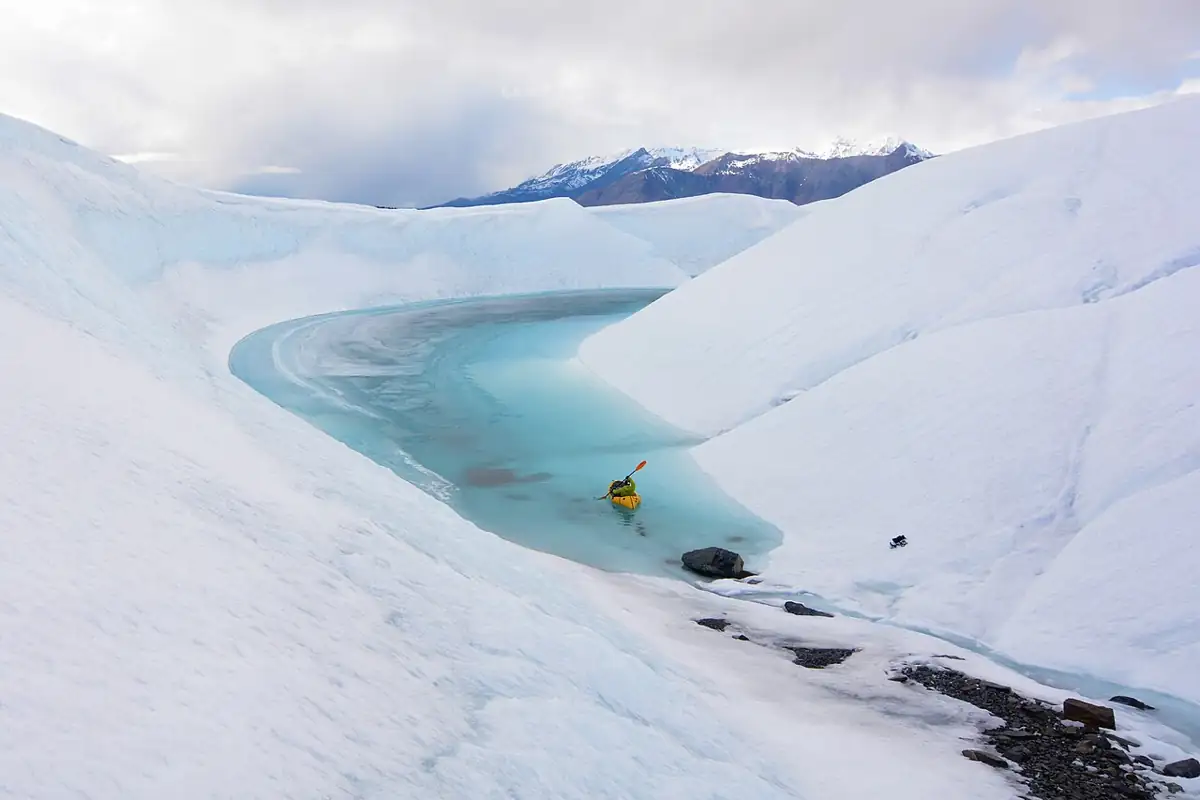
In winter a packraft can be a sled. In spring it can be your way off a glacier. Two trips show the range, one gentle and one that tested everyone on it.
Last checked November 2026
Most people put the packraft away when the snow falls. On snow, though, the boat makes a decent sled. In spring, when rivers start running off the ice, it can take you out of mountains that would otherwise need a helicopter. After the two trips below come notes on season timing, avalanche and meltwater risk, and gear weights.
A hut trip with a sled
A small group headed to the Shrine Mountain Inn cabins near Vail Pass, part of Colorado's 10th Mountain Division hut system. The winter route follows Shrine Pass Road for about 2.5 miles to the pass, then a short trail through the trees to the cabins. It is a gentle trip and a common first hut outing. Huts in the system need a reservation.
Instead of loading their packs, they ran webbing from a packraft's D-rings to harnesses and towed about 50 pounds of gear behind them. On a firm snowpack the boat slid well, and since it weighed about five pounds it added little to the load. The idea works for skiers and snowshoers alike: weight moves off your back and onto the snow.
The cabins came with cookware and a wood-fired sauna, so the gear list was short. They woke to about six inches of new snow and, having left the skis at home, spent the morning sledding a steep little hill in the raft. The D-rings held up fine to a day of dragging.
Rigging a packraft as a sled
- Run two lengths of webbing or cord from the bow D-rings, one per side, so the boat tracks straight instead of fishtailing.
- Tie them to a hip belt or a simple harness, not your shoulders. Your legs do the pulling.
- Use a tether a little longer than your skis so the bow does not hit your heels on descents.
- Load heavy items low and toward the stern, and cover the load with a tarp or the spray deck so snow stays out.
- Inflate the boat only part way for towing. A soft hull follows bumps and is kinder to seams than a drum-tight one.
- On steep downhills, have a partner hold a rear line as a brake, or carry the boat.
Check the floor afterward. Crusty snow and hidden rocks scrape the underside, so a light boat used as a sled all winter will need patching sooner than one that only sees water.
From icefield to ocean
A much bigger plan came out of a winter evening in a pub in Canmore, Alberta. Four skiers wanted to explore the Monarch Icefield, south of Bella Coola in British Columbia. Helicopters are the usual way on and off, and they are expensive. If they flew in but found their own way out, the cost would be cut in half. On a laptop map the way out looked simple: ski down the Talchako Glacier, paddle the Talchako River into the Bella Coola River, and keep going to the Pacific. One of them suggested packrafts in place of a full-sized raft.
They allowed 22 days. A helicopter dropped the four of them, their food and their gear at the foot of Mount Satan on the icefield. The first clear morning gave good skiing. Then the weather turned. A storm with very high winds and constant snow kept them digging out their shelters every hour for about 32 hours. They let two shelters be buried so they could keep the third clear and still get some rest. Later, digging those shelters out took most of an afternoon.
With their ski goals gone, they loaded the packrafts as sleds and towed them across the ice toward the Talchako. Steeper downhill sections meant racing to stay ahead of the boats. Where the snow bridges over icefalls had softened, they crossed roped together.
Getting from the glacier edge down to the river took two long days. They shuttled loads over snow, rockfall and dense alder and devil's club, down a slope of about a thousand meters. A twisted knee could have stopped the whole trip.
Close to the glacier the main channel kept splitting, so they had to wade and drag the boats every hundred meters. One paddler pinned on a boulder in a silty rapid and floated off with a swamped boat. The first day covered about a kilometer and a half. The group had planned for a swim by the least experienced paddler. Throw bags were tied to the sterns, and the rule was to hold onto paddle and boat. When he flipped against a log, the plan worked: he grabbed a throw bag line, swam to shore and pulled the boat in.
Downstream the river came together. They ran long stretches of class II and III, portaged a couple of logjams and covered close to 40 km in one day. The grey Talchako met the brown Atnarko to form the Bella Coola, and two days later they crossed the inlet to finish at the sea.
When to go: season timing
Most ski and packraft trips happen in the weeks when snow still covers the high ground and the rivers below have opened. Go too early and the water is frozen; go too late and the snow is gone or rotten.
| Window | Snow | Rivers | What it suits |
|---|---|---|---|
| Midwinter | Deep, often cold and stable or storm-loaded | Low, iced over or frozen shut | Sled use only: hut trips, lake crossings on safe ice are a separate skill |
| Late winter to early spring | Consolidating, good for travel early in the day | Starting to open at low elevation | Ski in, paddle short open sections, long carries |
| Spring melt | Wet, weak in the afternoon, cornices failing | Rising daily, cold and silty, peaking with warm spells | Icefield exits and ski-to-river traverses for strong teams |
| Early summer | Patchy, high only | High and powerful, then dropping | Hike-in trips with snow travel near passes |
Rivers fed by snow and ice rise through the afternoon and fall overnight as the melt slows. A braided channel that is easy to wade at dawn can be a fast, cold torrent by late afternoon. Plan crossings and launches for the morning, and watch for the daily pulse on any stream gauge near your route before you commit.
Avalanche and cold water: two risks at once
Packrafters tend to watch the river and ski tourers the snowpack. A combined trip needs both kinds of judgement, often on the same day.
Avalanche terrain
Approaches to icefields and alpine rivers often cross or run beneath avalanche slopes. In the US and Canada, regional avalanche centers publish forecasts on a five-level danger scale from Low to Extreme, broken down by elevation band. Read the forecast for every day of the trip you can, and know how to read it. Everyone in the group should carry a transceiver, shovel and probe and have practiced a companion rescue. A recognized avalanche course, such as an AIARE course in the US or an Avalanche Canada AST course, is the place to learn this. A packraft and paddle on your pack also make you heavier and slower in the terrain, which is one more reason to keep exposure short.
Spring brings wet slides and cornice falls in the afternoon heat. Those same warm hours are when rivers rise. An early start helps with both.
Cold water after a cold day
Meltwater is close to freezing. A swim in it brings on cold shock in the first minutes and quickly takes the strength from your hands. After a day of skiing you may also start the river already tired, damp with sweat and short on food. That combination is when people make poor decisions on the water.
The pages on drysuits and layering for paddling and reading moving water cover the paddling side in more depth.
What the extra gear weighs
Ski and packraft trips mean carrying two kits. Weights vary a lot with the products you choose, so the figures below are rough ranges to plan with. Weigh your own gear before you set a route.
| Item | Approximate weight | Notes |
|---|---|---|
| Light flatwater packraft | About 3 to 6 lb | Good sled, fragile on rock and ice |
| Whitewater packraft with deck | About 7 to 12 lb | Needed for continuous class II and up |
| Four-piece paddle | About 2 to 3 lb | Carbon is lighter, fiberglass tougher |
| Paddling life jacket | About 1 to 2 lb | Low-profile cut fits under a pack hip belt |
| Drysuit | About 2 to 4 lb | The single biggest safety item on meltwater |
| Paddling helmet | About 1 lb | Can double as a ski helmet if certified for it, check the label |
| Inflation bag | A few ounces | Use it with dry hands, glove liners help |
| Avalanche rescue kit | About 3 to 5 lb | Transceiver, shovel and probe |
A whitewater setup plus avalanche kit easily adds 20 pounds or more to a ski touring load. That is why many groups choose the lightest boat that will handle the river and keep as much as possible inside the tubes. The river trip packing list is a good base, with the snow gear added on top.
Lessons from the snow
- A packraft makes a good sled. Use a harness and a long tether, and keep heavy gear low.
- Cargo zippers keep weight inside the tubes, so the boat is less top-heavy. The page on tube storage and TiZips explains the setup.
- Glacial rivers near their source braid and change daily. Budget extra time.
- Water is near freezing, so dress for immersion. The cold water safety page covers how.
- Talk through swim plans before you launch, as the Talchako group did. The self-rescue page explains the basics.
The Talchako trip was the kind of route that looked easy from the pub, which is why planning a packraft trip matters. For other snow-to-river ideas, see what you can do with a packraft or head back to the Journal.
Can I use any packraft as a sled?
Most will work on snow. Lighter boats wear faster on crust and rock, so check the floor after each trip and carry repair tape.
When is the best time for a ski and packraft traverse?
Usually spring, when snow still covers the high ground and rivers are open below. Exact timing depends on the year's snowpack and the river.
Do I need avalanche training for a ski and packraft trip?
If your route crosses or runs below avalanche terrain, yes. Everyone in the group should carry rescue gear and know how to use it.
What should I wear on the river after skiing?
A drysuit or other immersion layers, put on before you launch. Meltwater is cold enough that a swim in ski clothing is a serious emergency.
Should I paddle glacial rivers in the afternoon?
Mornings are usually lower and calmer. Melt-fed rivers often rise through the afternoon, so many groups paddle early and camp by midday.